



Just a couple of decades ago, discussions about parallel worlds belonged either to the realm of science fiction or to philosophical debates.
Today, they are a growing part of the digital infrastructure, attracting increasing attention, capital, and creative energy. Metaverses represent an entire ecosystem of interconnected virtual spaces where people create digital twins, work and relax, and shape new cultural habits.
But how are these worlds built? Why is there so much enthusiasm and skepticism around them at the same time? And most importantly, where is the line between virtual space as a supporting tool and virtuality as a new environment for human existence?
Metaverses Today
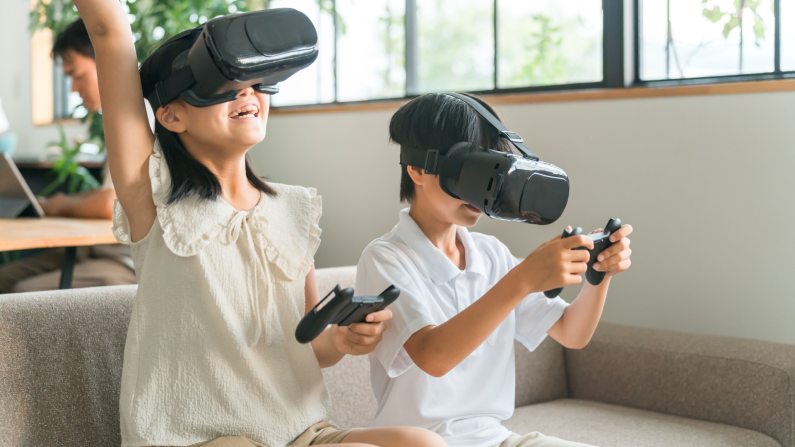
A metaverse is a persistent digital space where people can interact with others and with objects in real time. Unlike traditional games or social networks, three principles matter here: immersion, continuity, and creation.
Immersion provides the illusion of presence inside a virtual environment. Continuity means that the world continues to exist even when the user disconnects, “logs out.” And creation implies that users do not simply consume virtual goods but also build new cultural, infrastructural, and other objects — along with their own rules and economy.
Today, metaverses are evolving in several directions:
Game Worlds Become Platforms
Roblox, Fortnite, and Minecraft have long been perceived as more than just gaming environments. Users build their own spaces, host events, launch virtual businesses, and lead fully developed digital lives, complete with jobs, families, and hobbies. These worlds already function as social platforms where teenagers spend far more time than they do on traditional social networks.
Roblox is arguably the most striking model of a metaverse because everything is created by users themselves. The platform consists of millions of worlds built not by companies but by regular people — often teenagers.
Fortnite, for example, began as a shooter but quickly transformed into a platform where winning matters less than being part of a cultural flow. The most vivid illustration is the series of virtual concerts. Travis Scott’s 2020 concert drew more than 12 million viewers simultaneously — more than the capacity of the world’s largest stadiums. A giant animated avatar of the artist walked across the landscape, reshaped the island, and created new dimensions — all for an experience impossible to recreate in the physical world. Later came concerts by Ariana Grande, DJ sets, festivals — each time Fortnite turned into a massive digital theater.
Minecraft, too, has gone far beyond gaming. Its strengths lie in the simplicity of world-building and boundless imagination. Here we’ve seen:
-
virtual university campuses (such as Japanese schools holding graduation ceremonies during the pandemic);
-
historical reconstructions — from Ancient Rome to Jerusalem;
-
political initiatives like the “Uncensored Library,” where journalists placed texts banned in certain countries, housed as books inside Minecraft.
Corporate Metaverses — Workspaces of the Future
In today’s digital world, standard video-conferencing tools are becoming too limiting for large companies. Internal virtual offices offer more possibilities: product modeling, employee training, collective project visualization, and safe simulations. All this is enhanced by AI, which creates “living” environments tailored to specific teams.
A corporate metaverse typically includes:
-
digital twins of equipment, buildings, logistics systems, and even employees;
-
avatars for communication;
-
VR/AR training;
-
analytics;
-
access for remote employees;
-
integration with AI and core corporate systems.
For example, BMW has created digital replicas of factories using the NVIDIA Omniverse platform. Within these metaverse environments, engineers configure assembly lines in VR, test robot movements, model employee workflows, and optimize logistics.
Siemens is building the Industrial Metaverse for industrial enterprises, including:
-
digital twins of turbines, trains, and production lines;
-
VR simulations for engineers;
-
training programs for equipment maintenance;
-
real-time monitoring.
A digital twin of Germany’s railway infrastructure was developed, allowing specialists to test solutions in a virtual environment without risking actual traffic.
Accenture created its own metaverse, Nth Floor, where meetings and training sessions take place, HR conducts onboarding for new employees, and global teams communicate as if in a shared office. The platform proved so effective that Accenture purchased 60,000 VR headsets for staff.
Deloitte, in turn, uses metaverses to run seminars, model clients’ business processes, host consultations in virtual offices, and train employees through AR-based simulations. This accelerates consultants’ work across different regions.
Nike built Nikeland (inside Roblox), which is not a game but rather a marketing and corporate platform. Fans create their own athletic content, test virtual collections, and participate in digital sports activities. It has become an effective branding tool.
Educational Metaverses
Universities and schools are experimenting with virtual laboratories, lecture halls, and historical simulations. The idea is simple: experience-based learning is more memorable than text or video.
Using virtual and augmented reality, students can explore Ancient Greece, understand how the human nervous system works, safely conduct chemical reactions with rare elements, or converse with historical figures. Among VR educational content are the Apollo 11 VR space simulator, virtual fine art museums, and galleries such as the Museum of Fine Arts. Stanford even offers full VR-based courses — for example, “Virtual People.”
Social and Creative Worlds
VRChat, Somnium Space, and Horizon Worlds serve as spaces for self-expression that may be inaccessible in real life.
If three-dimensional games are built around gameplay, VRChat is pure social reality. There is no goal or narrative — each user creates their own avatar, environment, and communication style.
People meet, form communities, create virtual clubs, and even entire districts. There are VR communities staging theater productions, hosting philosophical debates, or running virtual talk shows. For people with limited mobility, VRChat has become a gateway to social life unavailable in physical reality.
VR, AR, XR: How the Boundaries Between Realities Blur

The term “metaverse” is often associated with VR headsets, but that’s not always accurate. The metaverse is a concept, while VR, AR, and XR are tools that provide different levels of immersion.
VR — Virtual Reality
A complete transition into a digital world. The user is transported into an artificial environment, leaving physical surroundings behind. VR creates a sense of “bodily” presence in another dimension — a key part of its appeal.
AR — Augmented Reality
Virtual elements appear on top of the real world. The most widespread examples are smartphone filters or navigation projections on smart glasses. AR is used in retail and marketing — for instance, virtual clothing try-ons — and is more integrated into daily life than VR.
XR — Mixed Reality
XR combines VR and AR into a hybrid: virtual objects coexist with real ones, react to the environment, and can become part of physical space. XR is considered a long-term “bridge” toward a full-fledged metaverse where boundaries between worlds eventually dissolve.
Economics of the Metaverse: Digital Assets, Professions, and Brands
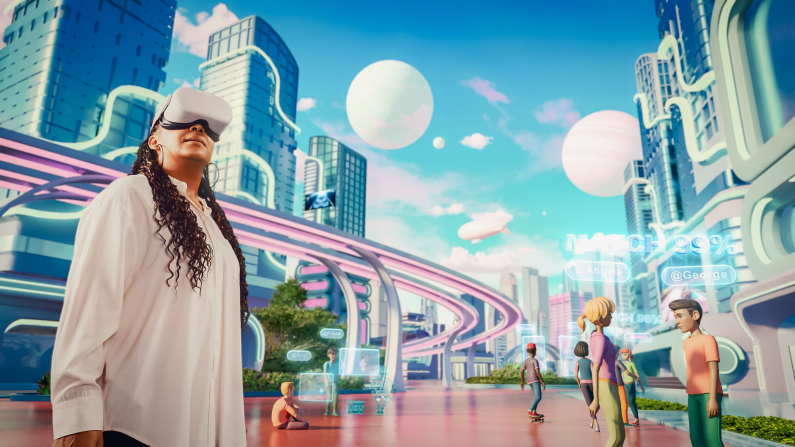
The metaverse economy is no longer experimental — it is a billion-dollar market. While the hype around NFTs surged and faded, the idea of digital ownership remains central.
Digital assets include not only images or collectibles. They encompass:
-
clothing for avatars;
-
virtual real estate;
-
creative tools;
-
models, scripts, animations;
-
digital goods and services.
On platforms like Roblox Marketplace and Fortnite Creators, users sell digital items just as Etsy sellers offer physical ones.
Most metaverses have internal currencies used for:
-
purchasing digital goods (clothing, avatars, weapons, effects, houses);
-
paying for services (world creation, avatar design, training, event hosting);
-
player-to-player trading;
-
paying content creators.
Robux is Roblox’s currency; V-Bucks is Fortnite’s. Some currencies cannot be withdrawn into real money, while others — especially crypto-based ones — can.
Although Second Life is discussed less today, it was the first world to introduce a fully functioning economy with currency, real estate, and businesses. Its economy was so realistic that:
-
virtual realtors sold land plots;
-
clothing designers created avatar fashion lines;
-
architects built houses, clubs, and offices;
-
companies purchased “office space” in virtual districts.
In Decentraland, during the peak of metaverse hype, land prices reached $15,000–$40,000 per plot.
Metaverses have also given rise to new professions — virtual world designer, metaverse architect, digital character creator, space moderator, virtual marketer, and avatar stylist.
Many teenagers already earn significant income selling digital goods or running virtual shows. The metaverse economy resembles the early internet — chaotic, fast-moving, and full of potential.
Luxury and sports brands were the first to recognize these opportunities: Nike, Gucci, and Adidas experiment with virtual collections, shows, and quests. Other companies hold virtual conferences, test new ad formats, and develop digital influencers. Their goal is simple: to be where youth culture is forming — and that is increasingly inside virtual worlds.
Psychology of Immersion
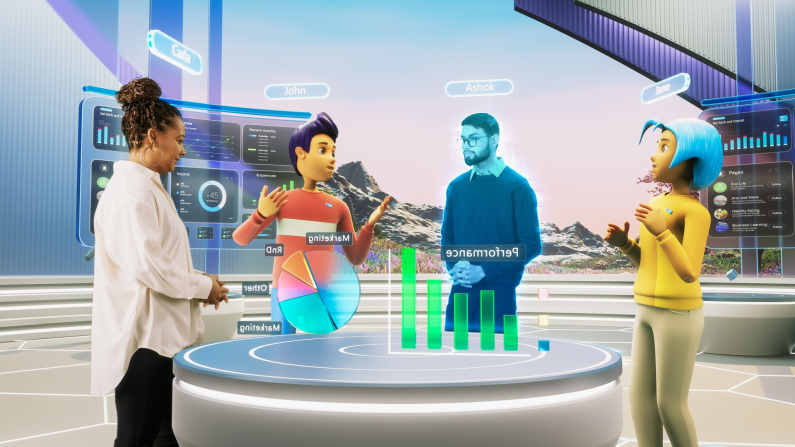
The deeper a person dives into virtual space, the sharper the question becomes: where is the boundary between life and play? The more realistic the environment, the more easily the brain accepts it as real. VR can trigger emotions as powerful as real-life experiences — fear of heights, euphoria, empathy.
An avatar becomes not just an image but an “extended identity.” A person may behave differently in a metaverse than in real life — bolder, more aggressive, or more open. This offers freedom but can also lead to a split between the real and virtual self.
Risks of Expanding Metaverses
Key risks include:
-
Addiction to constant presence.
Virtual worlds are often brighter, more controllable, and less stressful than reality.
-
Social isolation.
Paradoxically, one can interact with thousands of people in a metaverse while failing to build relationships in real life.
-
Distorted perception of time.
VR can absorb attention so deeply that hours pass unnoticed — leading to burnout, sleep disruption, and nervous overload.
-
Manipulation of attention and behavior.
Still, virtuality itself is not dangerous — lack of oversight is. The future of metaverses depends on how responsibly their rules and infrastructures are built.
Virtual worlds already influence the economy, culture, artistic practices, and social structures. They create new professions, new forms of art, and new modes of communication. But it is crucial to remember: the metaverse should not replace real experience. It can extend and enrich it — serve as a tool, a lab, a parallel reality, not a competing one.
It is likely that within our lifetime, people will live simultaneously in multiple realms — physical, digital, and virtual. And the degree to which we learn to switch consciously between them will determine whether the culture of the new era becomes liberating or restrictive.
Share this with your friends!

Evan Mcbride




 10
10
Be the first to comment
Please log in to comment