Articles

The best way to explain difficult concepts is by using simple language. In our longreads, we avoid using complex scientific terms, instead focusing on explaining everything that has to do with promising new technologies, scientific discoveries, and the problems that go hand in hand with technological progress. We strive to give you a detailed overview of the most important facts about technologies, in a way that’s not boring. In this format, we offer a comprehensive view of a particular event, issue or object without leaving out any important details or facts.

Beauty Requires Sacrifice. Can Robots Replace Humans in Beauty Salons?

Beauty Requires Sacrifice. Can Robots Replace Humans in Beauty Salons?

The beauty industry has traditionally been considered one of the most “human-centered.” What matters here is not only the skilled hands of a professional, but also contact, trust, and a sense of care — something that, it would seem, only a living, real person can provide to a client.
How Artificial Intelligence Changed Our World in 2025 and What to Expect in 2026

How Artificial Intelligence Changed Our World in 2025 and What to Expect in 2026

The year 2025 became the moment of maturity for artificial intelligence. If earlier AI was perceived as a trend that promised to “soon change everything,” now it has truly become part of reality — from business and science to everyday life. Companies are integrating AI into workflows, laboratories are running experiments on it, and users often don’t even realize that an algorithm making decisions is already working alongside them.
Hacking Sleep: How Caffeine Affects Your Dreams and Whether You Can Control It

Hacking Sleep: How Caffeine Affects Your Dreams and Whether You Can Control It

Sleep should not be considered merely a passive state of rest, as the brain can be quite active during this time. This is especially true during the rapid-eye-movement or REM sleep phase, when brain activity reaches almost the same level as during periods of wakefulness. It is in this phase that we experience our most vivid, complex, and intricate dreams. One of the factors capable of influencing the intensity, vividness, and indeed the very presence of dreams is caffeine.
The Era of the Seamless Interface: How Wearable Devices Are Changing the Rules of the Game

The Era of the Seamless Interface: How Wearable Devices Are Changing the Rules of the Game

At the beginning of this century, the "smartphone" sparked a true revolution, combining a phone, camera, navigator, bank, and personal computer into a single device.
Top of the Most Amusing Scientific Theories That Scientists Believe In

Top of the Most Amusing Scientific Theories That Scientists Believe In

Science is far from being just boring formulas; it is also an infinite space for fantasies, which are nonetheless conditioned by various logical conclusions.

Hackerless Attacks: How Autonomous AI Viruses Are Changing the Rules of Cybersecurity

Cyber threats have entered a new phase: hacker groups are being replaced by self-learning algorithms capable of finding vulnerabilities, creating exploits, and adapting to even the most serious defense systems without human involvement.

The Digital Glutton: The Truth About ChatGPT's Carbon Footprint

Training a single neural network can require an volume of water sufficient to fill a nuclear reactor, while our queries to ChatGPT create a carbon footprint comparable to industrial manufacturing. We have uncovered the price our planet pays for our dialogue with artificial intelligence.

Collaborator or Competitor? Why Generative AI Has Not Become a Full-Fledged Artist

When, in 2022, the Midjourney neural network generated the work "Théâtre D'opéra Spatial," which won a digital art competition in Colorado, it caused a shock. Many saw this as the sunset of human creativity.

Among Us: How Robots Are Creating a Brave New World

In recent years, we have been witnessing a large-scale technological revolution. Innovations are emerging at the speed of light — moreover, the very model of interaction between humans and machines is changing. It seems that not long ago, robots were associated solely with science fiction, but today they are deeply integrated into the everyday lives of both tech enthusiasts and ordinary people.

The Quantum Era: How New Computing Will Transform the World of Data

We stand at the threshold of a technological transformation comparable to the shift from steam to electricity or from analog circuits to integrated microprocessors. Today, the focus is on quantum computing—a technology that promises not merely to accelerate familiar computations but to redefine the very principles of how we interact with information. In this article, we’ll explore how quantum computers work, why they matter, and how soon quantum technologies may become part of our everyday lives.

Private Space Stations: What the Orbital Economy Looks Like in 2025

Today, more and more commercial orbital complexes are emerging, even though many people still associate the space industry with massive, exclusively government-run projects. Yet private stations now combine laboratories, hotels, and testing grounds all in one. This is how a new sector is taking shape — the orbital economy.

Neuroeconomics and AI: How Machines Are Changing the Job Market

A recent study has proven that artificial intelligence is no longer perceived as a revolutionary innovation or a novelty. Neural networks have long become a part of everyday life.

Clean Energy 2030: How Innovation Is Making the Planet Sustainable

We live in an era when addressing climate change and achieving an energy transition is no longer merely an environmental goal but a genuine technological front line — one where “green” technologies are becoming the driving forces of industry, economy, and social transformation. In this article, we explore how new materials and energy sources are helping the planet, what role artificial intelligence plays in this process, and which companies are leading the greentech revolution.

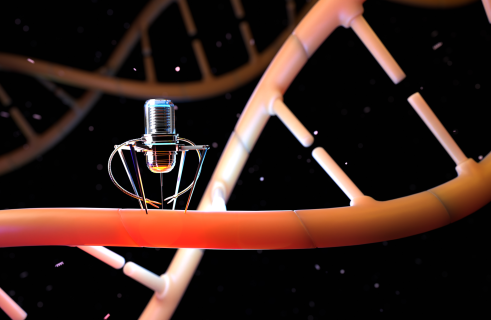
Genetics, Neural Networks, and the Medicine of the Future: Human 2.0

In the 21st century, medicine is undergoing a true revolution — algorithms are replacing doctors, 3D printers are printing human organs, artificial intelligence is designing drugs, and for the first time, humans can control their own biology and literally hack their bodies. Our very attitude toward health, aging, and the process of life itself has changed. But what will be the result of this revolution? Is it the key to immortality, or just another form of dependence on technology?

Climate Under Control: How AI Predicts the Weather

Until recently, forecasters relied on vast amounts of data from meteorological satellites, ground stations, weather radars, and other sources (e.g., ocean buoys, radiosondes), which is received in real-time.

The Post-Password Era: What Will Replace Biometrics in the Coming Years

Until recently, biometrics—fingerprints, facial scans, or iris recognition—seemed the pinnacle of digital security.

Human and Device: What’s New in the World of Smart Gadgets

We live in an era when digital technologies are becoming not just auxiliary tools but literally a part of our bodies — an intuitive environment and an interface for consciousness.

The 9/9/6 Schedule, Game Corporations, and Other Wonders of the IT Business in China

The Chinese IT market is a vast and dynamically developing digital landscape that has attracted global attention for several years.

Top 5 Cutting-Edge Chinese Inventions Set to Conquer the World in 2025-2026

The Chinese IT market and the country’s high-tech industry are steadily in the spotlight of the global community. The dynamically developing digital economy, which is projected to exceed $7 trillion by 2025, confirms China’s status as one of the main technological locomotives on the planet.

“Hello, Laowai!” Or What a Foreign IT Business Needs to Be Prepared For in China

The Chinese IT market is a real El Dorado for ambitious companies dreaming of global success. The numbers speak for themselves: China’s digital economy exceeds $7 trillion, and the number of internet users has reached 1.1 billion.

Ticket to Weightlessness: How Space Became an Entertainment Industry and Orbit — the New Attraction

Back in the 20th century, space was accessible only to astronauts — though ideas about its commercialization were already being discussed as early as the 1960s. Today, several decades later, more than 50 people have become space tourists, joining research missions without being professional astronauts. So, how much does a space trip cost? Can anyone go to space — and what does the future hold for this new entertainment industry?

Artificial Intelligence in China: From Facial Recognition to Intelligent Cities

China is rapidly transforming into a global leader in artificial intelligence, actively implementing it in all areas of life – from everyday tasks to complex technological solutions.

The Elon Musk Phenomenon: From His First Video Game to Spacecraft

One of the richest people on the planet, a technological genius, and a conqueror of space, Elon Musk successfully combines engineering talent with entrepreneurial vision. How did a schoolboy with a broken nose, beaten by classmates, go on to build a business empire and become one of the key figures in the White House?

Smart Homes 2.0: How to Move Into a Sci-Fi Movie Today

Remember those movies about the future where everything starts up, is repaired, and prepared for your morning wake-up automatically?
1 2 3 4 5 6 7 8 9 10 ... 14 15