



Not so long ago, a conversation with artificial intelligence resembled a dialogue with an erudite yet somewhat detached interlocutor.
We would ask AI for text analysis, image generation, or a brief historical reference, but each query required clear, extremely precise wording. Today, reactive chatbots are being replaced by a new generation — AI agents. These are full-fledged autonomous digital entities capable of setting their own goals, planning sequences of actions, and executing complex, multi-step tasks in the real world with minimal human intervention. Let's explore how these autonomous assistants are built, where the line lies between a "smart" assistant and a full-fledged agent, and how they are already changing approaches to work, creativity, and process management.
Who Are AI Agents?
The concept of an autonomous agent capable of goal-directed behavior is not new. Its roots trace back to the mid-20th century, to the work of pioneers in computer science and cybernetics. As early as the 1950s, Alan Turing, in his essay "Computing Machinery and Intelligence," pondered the possibility of creating machines capable of "learning from experience." However, for a long time, this idea remained within the realm of theoretical science and science fiction.
The breakthrough became possible only in the last few years due to the convergence of three key technologies:
Large Language Models (LLMs), such as GPT-4, Claude, or Gemini. They enable agents to understand complex, ambiguous natural-language instructions, generate meaningful plans, and communicate.
The development of reasoning-based architectures. A direct answer to a query is often insufficient for a complex task. Modern agents use techniques like Chain-of-Thought or Tree of Thoughts, which force the model not just to give an answer, but to "reason" step by step, evaluate options, and choose the optimal path.
Access to tools. AI agents are provided with API keys — digital "skeleton keys" — to access external services such as search engines, databases, calendars, email clients, booking platforms, and corporate ERP systems. The model learns to decide for itself which tool to use at a given moment to achieve the goal.
Thus, if a classic chatbot is a reactive system (query → response), then an AI agent is a proactive, goal-oriented system. It can be described by a simple formula: "Goal Understanding → Planning → Action Using Tools → Result Analysis → Plan Correction." This cycle repeats until the task is completed or an insurmountable obstacle arises that requires human intervention.
How the Agent's "Brain" and "Hands" Work: The Specifics of Autonomous Functioning
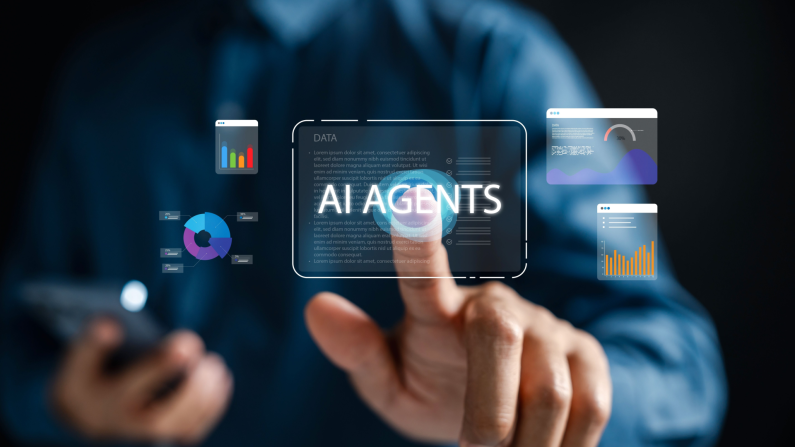
Technically, this process looks like this:
Goal Definition and Decomposition. The user gives a high-level command: "Prepare everything for the quarterly project meeting next Wednesday." The agent breaks this goal down into subtasks: find a date and time that work for the participants' calendars, book a meeting room, gather current project data from the CRM and Google Drive, prepare a draft presentation based on a template, and send invitations with an agenda.
Planning and Tool Selection. At this stage, the agent's "brain" (LLM) creates a sequential plan. It determines that first it needs to check participant availability via the calendar API, then request data from the CRM, and only then open Google Slides to create the presentation.
Execution and Feedback. The agent begins executing the plan, activating tools. If the calendar API returns an error (e.g., the room is booked), the agent won't stop. It will "think": "Goal — to hold the meeting. Obstacle — the room is occupied. Alternative — find another room or suggest a different time." And it will continue execution after adjusting the plan.
Final Report. Upon completion, the agent doesn't just finish the task. It reports to the user: "Meeting scheduled for Wednesday, 2:00 PM in Room N. Invitations with data access have been sent to all participants. The presentation draft is available via the link. I have highlighted three key risks from the report that require discussion."
Key Areas of AI Agent Application Today:
-
Personal Productivity: Automating routine tasks (email sorting, scheduling, summaries).
-
Customer Service: Not just answering FAQs, but solving a customer's problem from start to finish (order cancellation, refund processing, suggesting alternative products).
-
Research and Analysis: Autonomous data collection from multiple sources, their comparison, and compiling consolidated reports.
-
Software Development: An agent can receive a description of a new feature, break it down into tasks, write code, test it, and send it for human review.
Functions and Areas of Demand: From Hypotheses to Market Niches
The AI agent market is rapidly structuring, forming clear niches depending on the functions performed. They can be roughly divided into several archetypes.
-
Research and Analyst Agents. These are "digital interns" for working with information. Their strength lies in the ability to sequentially search, filter, and synthesize data from dozens of sources. Unlike a simple search, they don't return a hundred links; they prepare a structured answer.
-
Finance and Consulting: Automatic data collection on competitor companies, analysis of market trends, and preparation of first versions of investment memoranda.
-
Science and R&D: Search and summarization of the latest academic papers on a given topic, identification of research gaps, and assistance in hypothesis formulation.
-
Journalism and Media: Monitoring news feeds and social networks, primary fact-gathering for future materials.
-
Operator and Action Agents. The fastest-growing segment. These agents interact with digital and physical systems, executing predefined or adaptive scenarios.
-
Corporate Processes: Automation of HR (onboarding new employees, document collection), procurement (supplier search, comparison of commercial proposals), IT support (password resets, diagnosing simple faults via ticketing systems).
-
Customer Operations: Full support in e-commerce: from product recommendation on the website to order placement, delivery tracking, and return processing.
-
Smart Home and IoT: Coordinating device operation not by rigid rules ("turn on the light at 7:00 PM"), but by contextual scenarios ("the customer returned from a run — increase the temperature in the living room, turn on relaxing music, order the usual smoothie").
-
Creative and Strategic Agents. Here, agents act not as a replacement force, but as a catalyst and co-author. They expand the capabilities of professionals.
-
Marketing and Design: An agent can receive a brief, conduct competitor audience analysis, generate several creative concepts and text variations, and then independently test them on different audience segments on social networks.
-
Product Development: Based on user feedback, an agent can propose hypotheses for interface improvement, generate prototypes of new buttons or menus, and even create technical specifications for developers.
-
Strategic Planning: Assisting in modeling "what-if" scenarios for a business, taking into account numerous external factors (exchange rates, regulator actions, social media sentiment).
Real-World Cases: Who and How is Applying Agents
Theory is becoming practice in the offices and factories of leading companies that see agents as the next step after classic automation.
European Practices: Focus on Privacy and Industry
-
Siemens (Germany): Agents for Industrial Digital Twins.
The company integrates AI agents into its Siemens Industrial Copilot platform. Here, agents act as "interpreters" between human engineers and complex digital models of factories. An engineer can give the agent a natural-language command: "Analyze the data from the pump station sensors over the past week and identify anomalies that could lead to a line stoppage." The agent independently queries the system, processes the data, identifies patterns, and returns to the engineer not just a graph but a ready report with flagged risks and maintenance recommendations. This reduces time spent on routine analysis and helps prevent failures.
-
Klarna (Sweden): Agent as a Support Operator.
The fintech giant recently published results from deploying an OpenAI-based AI agent. This agent, in one month of work, performed tasks equivalent to those of 700 full-time support staff. It doesn't just answer questions; it also engages in meaningful conversations with customers, helps resolve payment issues, explains installment terms, and processes refund requests. According to the company, the agent resolves two-thirds of all inquiries, reducing the average problem-resolution time from 11 minutes to 2, while customer satisfaction (CSAT) levels remain unchanged. This is a clear example of the transition from a bot-with-a-script to an autonomous operator.
-
French Startup Mistral AI (France): Developing Open Platforms for Agents.
Europe is betting on technological sovereignty. The French Mistral AI, while creating its open LLMs (e.g., Mistral Large), focuses on enabling developers to build secure, controllable agents on its platform that comply with strict European GDPR norms. Their approach is to provide not a "black box" but a transparent toolkit that lets a company precisely tune the agent's behavior to its needs and ensure it doesn't overstep the bounds of permissible actions with customer data.
American Practices: Scale, Creativity, and Consumer Innovation
-
Cognition Labs: Developer Agent Devin.
This project caused a stir in the industry, being positioned as the first autonomous AI engineer. Devin is not just a code generator. It receives a task in natural language (e.g., "create a business card website for a small business with a contact form"), independently plans the architecture, writes code in several languages, tests it, finds and fixes bugs, and then deploys the result. In demonstrations, Devin successfully completed real tasks on the Upwork platform. Although mass adoption is still far off, Devin has signaled a trend: agents are beginning to master highly skilled creative professions.
-
Google (DeepMind): Graphical — Agents for Scientific Discovery
Researchers at DeepMind created the Graphical agent, capable of autonomous experimental planning in materials science. In a virtual lab, the agent was given the goal of discovering new stable materials. The agent independently planned the sequence of "synthesizing" virtual compounds, analyzed the results, and based on the obtained data, corrected further steps. In the end, it autonomously discovered 2.2 million new theoretically stable crystal structures, including 381 thousand with high potential for application in batteries and superconductors. This is an example of an agent as a new tool for scientific inquiry.
-
Consumer Technology Industry: Personal Agents of the New Generation.
Major players like Microsoft (Copilot), Google (Gemini), and OpenAI are actively moving from chat interfaces to an agentic architecture. Their products are increasingly gaining the ability to plan tasks. For example, Copilot in the future will be able not just to write an email but, upon receiving the command "organize a team-building event," to independently select a date, find suitable venues, compare prices, book the best option, and send confirmations to participants. The user sees only the final result.
Companies developing the Platforms on which these agents are built also fall into several camps:
-
Giants with Ready-Made Solutions: Microsoft (Azure AI Agents), Google (Vertex AI Agent Builder), Amazon (Bedrock Agents). They offer turnkey solutions integrated into their cloud ecosystems.
-
Specialized Startups: CrewAI, LangGraph, AutoGen. These platforms offer greater flexibility for developers, allowing fine-tuning of the logic for the interaction among multiple agents (e.g., one researcher agent passes data to an analyst agent, which, in turn, generates a report for a communication agent).
-
Open Communities: Projects like OpenAI Assistants API or open models like Llama 3 from Meta stimulate the creation of millions of experimental agents, accelerating innovation and identifying successful use cases.
The Key Feature of AI Agents lies in their autonomy and their ability to take coherent actions. They do not replace humans overnight, but they fundamentally change their role: from performing routine operations to setting tasks and strategizing.
Thus, questions of adaptation, ethics, and governance come to the forefront. What will happen when millions of agents begin interacting simultaneously in markets? How to ensure their safety and prevent unintended actions? Who is responsible for a decision made by an autonomous agent? While regulators seek answers, businesses are already spending enormous budgets on AI agents. In the next 2-3 years, we will see explosive adoption of such systems, first in niche corporate processes and then in mass consumer services. The ability to formulate tasks for such systems, control their work, and interpret results will become one of the key complementary skills to AI — the very skill that will determine a specialist's value in the new, agent-human economy.
Share this with your friends!

Evan Mcbride




 10
10
Be the first to comment
Please log in to comment