


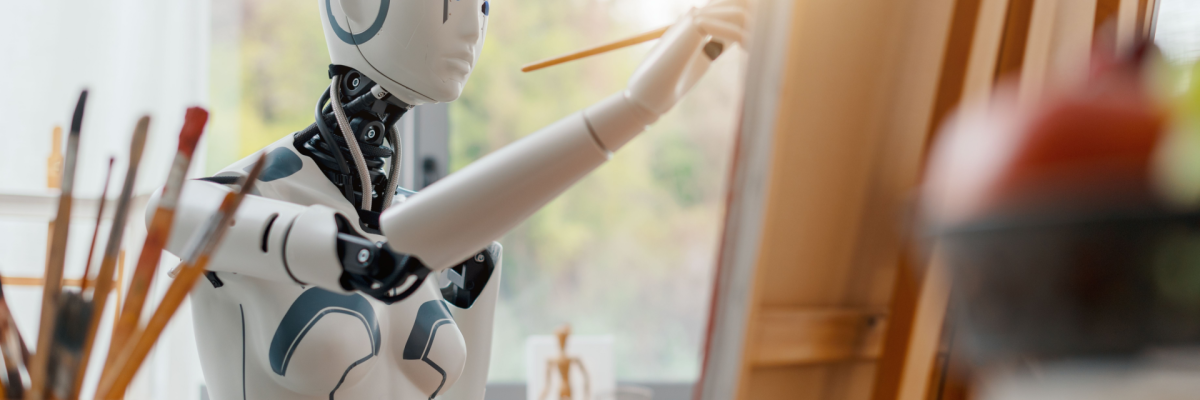
Artificial intelligence, which until recently was merely a tool for analytics and simple automation, has learned to create in a truly creative way. It is now a full-fledged co-author in art, science, and creative exploration.
The market, valued in the billions of dollars, is rapidly evolving: according to the consulting firm McKinsey, by 2030, generative AI technologies could add $2.6 to $4.4 trillion in annual value specifically to creative sectors.
Today, creatives increasingly see AI not as a threat at all, but as a digital twin, a partner, a co-author. This symbiosis gives rise to new business models and professions, but simultaneously intensifies old conflicts: about copyright, originality, and the very essence of creativity. Even now, courts in the United States and the European Union refuse to recognize copyright for works created exclusively by AI, emphasizing the necessity of "substantial human creative contribution." Concurrently, startups are entering the creative market, offering to generate a logo, a musical jingle, or an advertising text in a matter of minutes, challenging traditional studios. Let's explore how the creative conveyor belt works and examine real-world cases from the worlds of fashion, cinema, music, and science.
How AI Produces Art
Of course, AI does not experience emotions or think in images. At the core of modern creative AI lie generative models, particularly transformers. They ingest terabytes of data:
-
For music production — all digitized scores by Bach, The Beatles, Led Zeppelin, and Lady Gaga, broken down into notes, chords, and instrument timbres.
-
For writing texts, it has access to all of Wikipedia, plus millions of books, plays, articles, and blog posts, where the algorithm studies connections between words, stylistic features, and narrative structures.
-
For image generation — hundreds of millions of paintings, photographs, and sketches with descriptions. AI learns to understand that the combination of pixels a human called "Starry Night" is statistically linked to the words "Van Gogh," "blue," "swirl," "stars," and "Post-Impressionism."
Imagine we want AI to write a song in the style of the Liverpool quartet — The Beatles. We don't give it a finished text, but we "feed" it:
-
Data: All the band's studio albums as MIDI files (where every note of every instrument is specified) and song lyrics.
-
Architecture: A model similar to OpenAI’s Jukebox or MuseNet, which learns to predict which note or chord should follow in a given musical context.
-
Prompt: We set the style — "The Beatles, 1967, psychedelic rock, major key, presence of sitar." We can add "theme — flight and weightlessness."
The algorithm begins its work. It doesn't simply copy chunks from "Lucy in the Sky" or "Tomorrow Never Knows." Instead, it analyzes the band's other compositions and, based on these millions of identified probabilistic connections, generates a sequence that statistically best matches the query "The Beatles song." The result is a composition that will astonishingly accurately convey the group's spirit and sound, yet be entirely new. It might be banal, or it might—by chance and successful tuning—offer an unexpected and fresh twist that would appeal to both the musicians themselves and their fans.
Real-World Cases of AI Co-Authorship
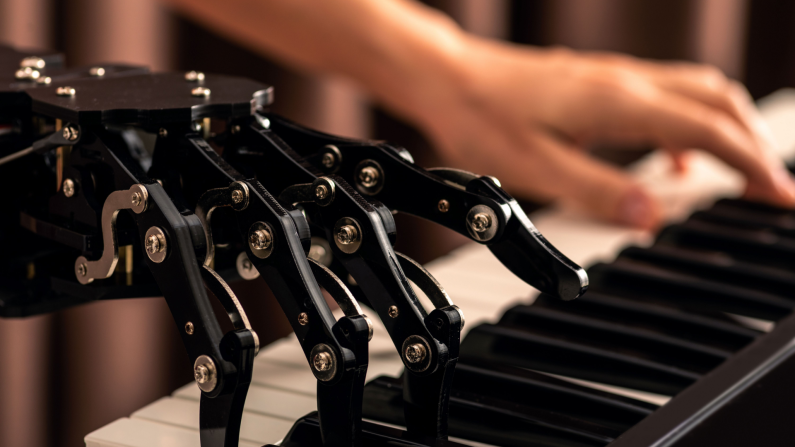
AI is already stepping onto the stage, into galleries, and into research centers, demonstrating its potential.
-
Theater and Literature: "Juliet" with Open Source
For example, in 2023, a short play titled "AI: When a Robot Writes a Play," created by the GPT-4 language model for a theater lab, was staged in Prague. Actors admitted that the dialogue felt somewhat banal and too "dry," but the plot twists turned out to be provocatively original. For several years now, literary prizes have existed in the publishing world for works written with the help of AI (for instance, in Japan). The novel "The Day a Computer Writes a Novel" passed the first round of a national literary prize back in 2016. Writers are increasingly using tools like Sudowrite or Jasper to overcome "writer's block": the algorithm can suggest ten plot developments, describe a landscape in Hemingway's style, or come up with a vivid metaphor for a sense of loss.
-
Science: "Halicin" and the Hunt for New Medicines
Perhaps the most significant practical example is the discovery of a new, powerful antibiotic with the help of AI. Scientists at the Massachusetts Institute of Technology (MIT) faced a crisis: the discovery of new antibiotics had slowed, while bacterial resistance was growing. They trained a model on a library of 2500 molecules with known properties. Then they "fed" it a database of 107 million chemical compounds, asking it to find those that effectively destroy the bacterium Acinetobacter baumannii (one of the most dangerous hospital-acquired infections), while being safe for humans.
The AI analyzed the molecular structures and predicted several thousand candidates that, from the algorithm's perspective, should work. Among them, scientists selected and synthesized one. It turned out to be unlike known antibiotics and astonishingly effective. They named it Halicin — after HAL 9000 from "2001: A Space Odyssey." It is currently undergoing preclinical trials. This is not composing music, but it is an act of the highest scientific creativity: discovery. AI achieved it by finding non-obvious patterns in data that a human could not possibly have encompassed.
-
Fashion: Digital Couturiers
In the spring of 2023 at Milan Fashion Week, one of the most discussed looks in the Coperni brand's collection was created with the direct participation of AI. Designers used the Midjourney neural network to generate thousands of images of futuristic silhouettes, textures, and prints based on prompts like: "liquid silver, biomimicry, Zaha Hadid architecture, sculpture dress." The algorithm suggested a form, which the designers then interpreted in real fabrics. The result was a dress that critics called "a glimpse from the future."
British designer Iris van Herpen has collaborated for decades not with AI, but with engineers and scientists, using 3D printing and algorithmic design to create her sculptural outfits. Now, however, the tools have become more accessible. Startups like Vizcom or Stitch.ai allow designers to visualize a sketch on a virtual model in seconds, instantly changing the color, fabric, or cut, simply by describing what they want in text.
-
Visual Arts: "Portrait of Edmond de Belamy"
In 2018, the painting "Portrait of Edmond de Belamy," created by the Parisian collective Obvious using a GAN (Generative Adversarial Network) algorithm, was sold at Christie's for $432,500. It was a turning point. Since then, the AI art market has exploded. Platforms like DALL-E 3, Midjourney, and Stable Diffusion allow any user to become a "commissioner" of art. But true artists use them not for one-off pictures, but as part of a complex process. For example, artist Refik Anadol creates giant immersive installations by "feeding" neural networks archives of data (such as architectural blueprints of museums or visualizations of memories) and compelling them to generate visual flows that are then projected onto buildings. His work "Machine Hallucinations" is an attempt to allow AI to "dream" based on a given set of images.
The Ethical Question: Who is the Author, and Did AI Steal Our Art?
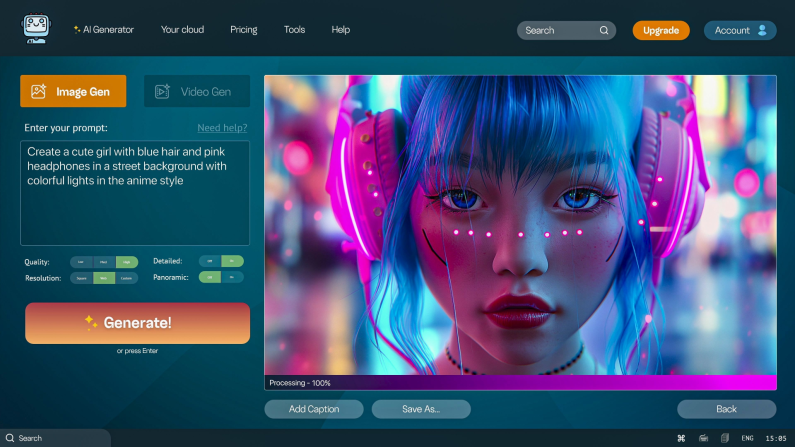
Where AI creativity appears, heated debates immediately arise. They can be reduced to three key questions.
-
The Question of Authorship and Originality
If a painting is sold for half a million, who gets the money? The programmer who created the algorithm? The artist who came up with the prompt and selected one from a hundred generated variants? The owners of the data on which the model was trained (i.e., the millions of artists whose works were "fed" to the algorithm without consent)? There is no legal answer yet. Patent offices and courts in the US and EU are already refusing to register copyright for works created exclusively by AI without "substantial human creative contribution." The human curator becomes the key figure.
-
The Question of Plagiarism and "Style Cannibalism"
Platforms like Midjourney were trained on billions of "image-text" pairs scraped from the open internet, including works by living artists. As a result, the algorithm can generate images "in the style of Hayao Miyazaki" or "in the manner of contemporary illustrator Greg Rutkowski" with frightening accuracy. Many artists are outraged: their unique style, honed over years, has been copied and mass-produced by a machine without their consent or compensation. Collective lawsuits have already been filed against the developer companies (for example, by a group of artists against Stability AI, Midjourney, and DeviantArt). This calls into question the very ethics of modern machine learning: can a commercial creative industry be built on a "pirated" copy of all human culture?
-
The Question of "Soul" and Devaluation
Will the accessibility of AI content lead to an inflation of creativity, where we are flooded with a stream of technically flawless but empty "simulacra"? Critics fear we will lose the connection to the unique human experience behind true art: pain, joy, and the author's life story.
Transformation: Not Replacement, but a Hyper-Tool
Despite the fear, many leading creatives see in AI not a rival, but an unprecedented expansion of possibilities:
-
The Artist as "Data Conductor": Refik Anadol does not paint himself. He creates an "orchestra" of data and algorithms, sets rules of play for them (e.g., "visualize the archives of the New York Public Library as a dream"), and then selects the most interesting machine "improvisations" for the final installation.
-
The Composer as Sound Researcher: Musicians use AI (for example, the Google Magenta or AIVA platform) to generate musical themes, which they then arrange and develop. AI can suggest an unexpected harmonic progression that a person, raised in tradition, might not consider. It becomes a "co-author in musical mathematics."
-
The Designer as Creator of Possibilities: Architects use generative design. Instead of drawing one building option, they give the algorithm parameters: area, materials, lighting, and budget. AI generates thousands, sometimes millions, of form options optimized according to the given criteria. The human selects the most aesthetic and practical one from this "evolutionary soup." This is how, for example, the AI SpaceFactory pavilion for NASA, 3D-printed, was designed.
A New Profession: Prompt Engineer for Creative Industries

Thus, a new key profession is born at the intersection of technology and art — the creative prompt engineer or AI conductor. This is not just a person who types "draw a kitty" into a box. This is a specialist who knows how to conduct a meaningful dialogue with AI in a special language and possesses:
-
Deep Domain Knowledge.
-
Decomposition Skill. Instead of "write a scary story," the prompt engineer gives: "Write the beginning of a story in the style of Lovecraft. Setting: an abandoned biological station in Antarctica. Character: a scientist who begins to hear a rhythmic knocking coming from the glacier. Style: clinically detached, with a buildup of paranoia. Use metaphors related to cold and decay."
-
Knowledge of Specific Models. Midjourney responds better to certain commands for stylization (e.g., "art deco," "cinematic lighting"), while for GPT-4, it is important to structure the query with a clear task statement.
Companies like Adobe are already integrating these capabilities directly into their creative suites (Firefly), understanding that the future lies in hybrid tools where the artist's brush and the text prompt exist in the same interface. Creative agencies in New York and London are increasingly looking to hire not just designers, but "creative technologists" who possess these skills.
What Lies Ahead
AI co-authorship is a fundamental shift, comparable to the invention of photography (which did not kill painting but freed it from the task of merely copying reality, paving the way for Impressionism and abstraction) or the advent of digital audio workstations (which democratized music creation).
In the next five years, we will see:
-
Formalization of the Legal Framework: The emergence of licenses for AI art, attribution rules, and possibly royalty systems for artists whose styles were used in training.
-
The Flourishing of "Non-Human" Art: Algorithms trained on data from telescopes, brain activity, or climate models will give birth to absolutely new aesthetic forms that a human could not have imagined.
-
Personalization of Culture to the Extreme: AI will generate a soundtrack to your life in real time, illustrate a book to your taste, or design an interior by analyzing your emotions.
-
New Value for "Handmade" and "Authentic." As a reaction to digital abundance, demand will grow for things with a documented human history of creation, just as vintage and handmade are valued today.
Share this with your friends!


 10
10
Be the first to comment
Please log in to comment