



Today, following the Apollo era, a new age has dawned in which the Moon is viewed as the first extraterrestrial logistics hub, an industrial platform, and a testing ground for all manner of technologies.
The new lunar race is a strategy for the systematic development of our satellite. Its goals are no longer merely to visit the Moon but to settle there; not only to explore Earth's only natural satellite but to utilize it to maximum advantage. We decided to find out which specialists have already begun developing the Moon and what their plans entail.
From Galileo to Artemis
Humanity has observed the Moon since prehistoric times, but it was only in 1609 that it became the first celestial object studied with instruments. Galileo Galilei began systematically examining the satellite using a telescope. On November 30, 1609, he first observed and sketched mountains, craters, and "seas" on its surface, proving it was not perfectly smooth as scientists had previously believed.
The scientific and practical exploration of the satellite began in the space age: in 1959, the Soviet station Luna 2 first reached the lunar surface, and in 1969, Neil Armstrong's foot left a print in the regolith. Today, the Moon is primarily an object for scientific research (orbital spacecraft from NASA, ESA, and ISRO study its geology, composition, and exosphere), but it has also become a testing ground for perfecting landing technologies, rovers, and communications. However, a key shift occurred with the launch of NASA's Artemis program and similar private initiatives worldwide. Their goal is to ensure a sustainable human presence on the Moon.
A New Role: The Moon as a Logistics Hub and Refueling Station
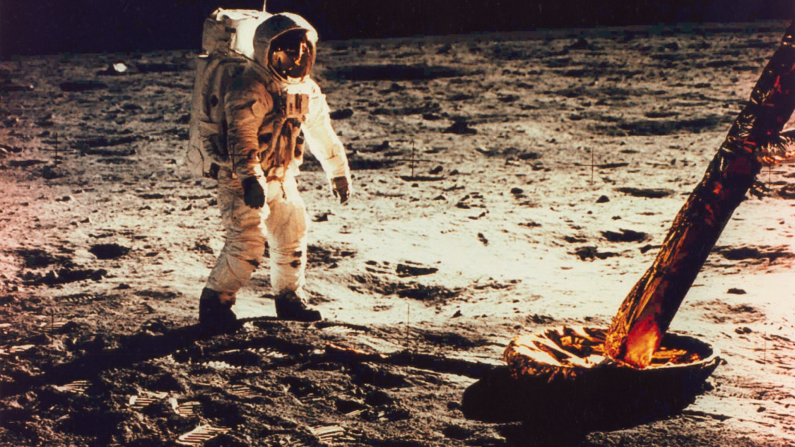
Why is the Moon ideal for the role of the first spaceport? The answer lies in energetics. Launching from Earth requires colossal energy expenditure to overcome its powerful gravity and atmosphere. The Moon, however, has weak gravity (six times weaker than Earth's) and is practically devoid of an atmosphere. This makes it an ideal launch pad for missions into deep space.
But to refuel ships, you need fuel. The Moon's primary resource is water ice, concentrated in polar craters. It is critically important as a source not only for life support (water, air) but, most importantly, for rocket fuel (hydrogen and oxygen) obtained through electrolysis.
Experts suggest the future lunar hub will operate on the following principle:
-
Extraction of ice from polar craters;
-
Separation into oxygen and hydrogen, followed by liquefaction;
-
Storage in cryogenic depots;
-
Refueling of ships headed to Mars, asteroids, or lunar orbit.
This transforms the Moon from a destination into a kind of transit point, significantly reducing the cost and increasing the efficiency of the entire architecture for exploring the Solar System.
Proving Ground for Critical Technologies: What's Being Tested at Shackleton Crater
Before full-scale production can be deployed, technologies must be perfected in the Moon's harsh conditions. The Moon's low orbit and its surface have become a unique laboratory. However, the nuances are many:
-
Lunar Internet and Navigation: On Earth, we use GPS and the global internet. For work on the Moon, analogous infrastructure is needed. Projects like NASA's LunaNet and similar developments by ESA envision creating a network of communication and navigation satellites in cislunar orbit. This will allow rovers, bases, and astronauts to determine their location precisely and have a reliable communication channel with Earth and among themselves—the foundation for any coordinated activity. Private companies like Astrobotic and Intuitive Machines are already incorporating elements of such infrastructure into their first cargo delivery missions.
-
Robotics and Autonomous Construction: Lunar conditions—vacuum, radiation, abrasive dust, and the long night (14 Earth days)—can be destructive not only for humans but also for machinery. Here, construction robots are being tested, capable of using D-Shape technology (3D printing using regolith as a binder) to erect domes for habitation and radiation protection. The American technology company Icon (a NASA partner) is already conducting such experiments on Earth, preparing technologies (e.g., the process and materials for printing with simulated regolith, autonomous robots for regolith mining and processing) for space use.
-
Energy Systems: A two-week night demands a fundamentally different approach to power supply. Compact fission nuclear reactors (a prime example being NASA's Kilopower project), capable of providing a base with energy for years independently of the Sun, are being tested, as are systems for wireless power transmission to supply stations in shadowed zones.
Who is Already Operating on the Moon Right Now

In fact, as fantastic as everything said above may sound, we are not talking about the distant future but about missions of the current decade. Work on lunar missions is already actively underway, for example:
-
CLPS (Commercial Lunar Payload Services) – a NASA program. Here, the agency acts not as an operator but as a customer, purchasing services for delivering scientific instruments to the Moon from private companies. This creates a market and stimulates the development of landers and rovers (from the likes of Astrobotic, Intuitive Machines, Firefly Aerospace). Their payloads are the first spectrometers for ice analysis, ground-penetrating radars, and sample collectors.
-
Regolith Mining and Processing: Startups like Lunar Resources and projects within SpaceX are working on creating regolith processing plants. The goal is to extract oxygen (up to 40% of the regolith's mass) and metals (iron, aluminum, titanium) for on-site construction. Pilot installations are planned for delivery to the surface within the next 5-7 years.
-
Private Lunar Missions: Companies like ispace (Japan) and SpaceX with its Starship HLS (Human Landing System) project are aiming not just for landing but for creating a regular transportation system and, in the case of Starship, for delivering large volumes of cargo (tens of tons) for infrastructure construction.
Forecast: From Proving Ground to Industrial Park
In 10-15 years, the lunar economy could reach a tangible level, and we will observe an entire network of objects with different specializations. For example, it is quite possible that the following could be built on the Moon:
-
A Fuel Farm – a complex for mining and producing cryogenic fuel;
-
An Equatorial Spaceport – with optimal trajectories for launch requiring minimal energy expenditure;
-
Scientific and Research Outposts in unique geological formations (e.g., lava tubes serving as natural shelters);
-
Lunar Communication Network Nodes, providing communication and navigation.
States (such as the USA and China) are already setting the rules and may provide the first contracts in the future, although construction and operation will likely be handled by private companies. The Moon will transform from a desolate world into a bustling construction site of the Solar System, where technologies will be created that will one day allow us to venture far beyond its limits.
Share this with your friends!

Evan Mcbride




 10
10
Be the first to comment
Please log in to comment