


When choosing clothes, you likely rely heavily on the weather forecast. But just imagine a jacket that easily becomes a windbreaker in the subway and a warm down jacket in the cold.
Today, this no longer sounds like science fiction but is becoming part of everyday life. Materials engineers are actively developing a new, fundamentally different class of substances—"smart" or adaptive materials. They are capable of changing their key properties—shape, transparency, thermal conductivity, density—in response to specific external stimuli: temperature, pressure, humidity, or an electrical signal. The result is fabric that regulates heat exchange on its own, among many other materials. Let's find out how physical objects around us are acquiring a semblance of reactions and reflexes.
What Can "Programmable" Matter Already Do?

Classic materials—steel, wood, ordinary plastic—behave predictably. Their properties are constant. "Smart" materials, or materials with adaptive properties, are an entirely different class. Their key feature is the reversible change of characteristics (shape, color, density, thermal conductivity) under the influence of an external stimulus: temperature, pressure, electric current, a magnetic field, or even the chemical composition of the environment.
Here are several principles that form the basis of this concept:
- Metamaterials: Controlling the Invisible
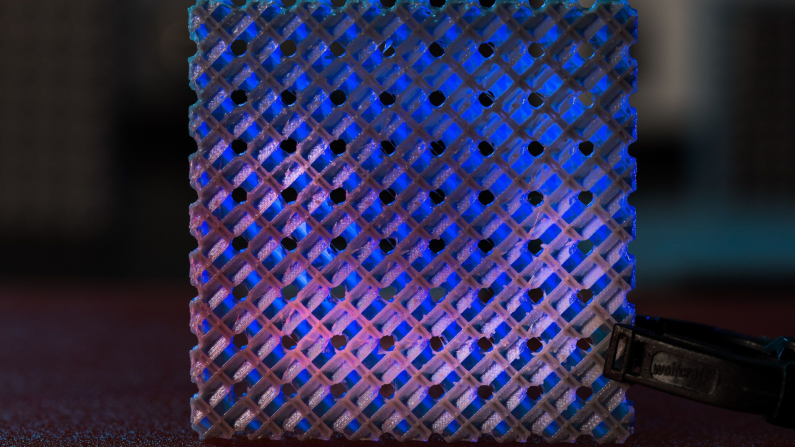
Metamaterials are not new chemical elements but artificially created structures with a periodic architecture (often in the form of microscopic rods, rings, spirals). Their "magical" property is the ability to control electromagnetic waves, including light and heat, in ways impossible in nature. Due to their precise geometry, they can, for example, make light bend around an object, rendering it invisible within a certain range, or focus heat into a narrow beam.
This is fundamental science actively pursued by leading universities (like MIT and Harvard) and defense agencies (such as DARPA in the USA). Among practical startups, the company Metamaterial Inc. (Canada) stands out; it created the technology for "smart" aircraft windows that dynamically tint without an electrical current, and its developers are also working on similar coatings for unmanned aerial vehicles.
- Shape-Memory Polymers (SMPs): A Material with Memory
Such a polymer can be deformed (stretched, crumpled), but when heated to a specific temperature, it returns to its original shape, which it remembers. The secret lies in a special molecular network that switches between flexible and rigid states.
The technology has already left the laboratories. The German chemical giant BASF and the American Cornerstone Research Group are developing based on them self-deploying elements for spacecraft, smart medical stents (tubes inserted into a vessel in a compressed form, which then expand from body temperature), and even prototypes of car bumpers that regain their shape after a minor collision.
- Hydrogels Harvesting Water from Air
These polymer networks can absorb and retain vast amounts of water—hundreds of times their own weight. A new generation of "smart" hydrogels, often based on the hygroscopic material MOF (Metal-Organic Frameworks), works like a timer-activated sponge. At night, in cool and high humidity, they absorb water molecules from the atmosphere. During the day, under the influence of solar heat (that very external stimulus), they abruptly change structure and release clean, condensed water. These materials exist in different forms depending on the stage of development and purpose, but their appearance is often deceptively simple. MOF-based hydrogels most often look like a fine powder, similar to icing sugar or baking soda. Polymer hydrogels (the more classic kind) in a dry state resemble fragile, semi-transparent granules.
The startup Watergen (Israel) has created industrial water generators from air. The laboratory of Professor Omar Yaghi (University of California, Berkeley), one of the pioneers of MOFs, collaborates with companies to create personal portable devices for arid regions. This technology is already undergoing field trials.
From the Life of Supermaterials
These laboratory wonders are gradually penetrating our reality, promising to make it more convenient, safer, and more eco-friendly.
- Clothing with a Microclimate
The basis is phase-change materials (PCMs), such as paraffin microcapsules sewn into the fabric. When the body overheats, they melt, absorbing excess heat and cooling you down. When cooling occurs, they crystallize, releasing the stored heat. More complex systems, being worked on at MIT, use bicomponent fabrics: when humidity and temperature rise, their fibers change geometry, opening pores for ventilation.
Sports brands like The North Face and Under Armour have been experimenting with PCMs in their lines for extreme sports for several years. The startup Ministry of Supply uses shape-memory materials to create suits that don't wrinkle and adapt to body movements.
- Self-Healing Asphalt and Concrete
Microcapsules containing a special polymer or bacterial spores are added to the concrete mixture. When a microcrack forms in the material and water gets into it, the capsules rupture. Either the polymer hardens, filling the cavity, or the bacteria activate, feed on calcium lactate, and produce limestone, which "heals" the damage. This drastically increases the lifespan of structures.
The Dutch company Deltares successfully tested self-healing asphalt on a bicycle path. The company Basilisk Concrete (Netherlands), for example, already sells innovative self-healing concrete that "heals" cracks thanks to special bacteria added to the mixture. When moisture enters a crack, these microorganisms activate, produce limestone (calcium carbonate), which fills the crack, making the concrete waterproof and extending the structure's service life without the need for manual repair.
- "Breathing" Smart Walls and Windows
For example, walls based on porous hydrogel panels can absorb excess moisture from the air in a room and, when the air is dry, release it back. Windows with electrochromic coating (from View Inc.) tint on command from a sensor, reducing room heating. And at the University of Chicago, they created a prototype of a "smart" radiator coating: at temperatures above 18°C, it automatically switches to a mode that reflects solar infrared radiation to prevent overheating, and below that—absorbs it for heating.
Beyond scientific laboratories, construction giants like Saint-Gobain and Skanska are actively interested in this for creating energy-efficient buildings with a minimal carbon footprint.
Biomimicry—The Chief Designer of "Smart" Matter

Scientists rarely invent something completely from scratch. In fact, they have borrowed many ideas from nature, which over billions of years of evolution has honed the most effective mechanisms.
- From the chameleon, they borrowed the principle of color change. Its skin contains not pigments but nanocrystals, the distance between which changes. This changes the wavelength of reflected light—thus color appears. By analogy, strain sensors and "camouflage" materials are being created.
- Spider silk is the benchmark for strength and elasticity. Its structure, a combination of rigid crystalline and soft amorphous regions in protein chains, has inspired the creation of new types of synthetic fibers and composites that don't tear upon impact but stretch, absorbing energy.
- Sea sponges and mollusk shells are living textbooks on self-healing and strength. The process of biomineralization (how a mollusk builds its shell) and the ability of sponges to regenerate entire bodies from individual cells gave impetus to the development of bio-inspired self-healing polymers and super-strong ceramics.
"Smart" matter doesn't just serve humans; it interacts with them and the environment, solving problems even before we start thinking about them, saving energy and reducing waste. This evolution from creating things to designing the behavior of the material world is in full swing. And as practice shows, this behavior increasingly resembles the intelligent, almost living, adaptability of nature.
Share this with your friends!

Ethan Oakes



 10
10
Be the first to comment
Please log in to comment