



To go on a journey today, you no longer have to buy a ticket, book a hotel, or even leave your home. In fact, your destination does not even have to exist.
The internet has gradually developed its own form of tourism. People explore fictional spaces, draw maps of nonexistent corridors, walk through digital replicas of exhibitions that have already closed, and even visit museums dedicated to virtual worlds. Some of these places are created by artists and developers, while others emerge almost by accident and are expanded over the years by thousands of users.
In 2026, researchers from Lancaster University suggested taking this phenomenon quite seriously. Sophie James and James Cronin studied how people interact with one of the internet’s most famous fictional locations — the Backrooms — and described what is happening there as a kind of digital form of dark tourism. Only instead of visiting an abandoned building or the site of a disaster, the traveler goes somewhere that has never existed in the real world.
And if ordinary tourist attractions have suddenly started to feel boring, this kind of journey is probably best begun in a place where it is easy to get lost even with a map.
First Stop: The Backrooms
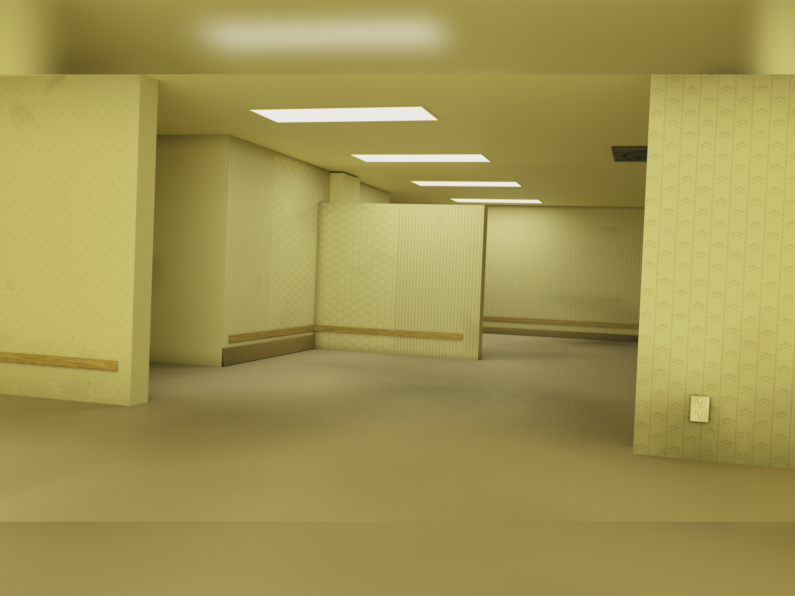
Imagine an empty room with yellowish walls. There is an old carpet on the floor, fluorescent lights hum overhead, and there are no windows or people. Behind the door is another room that looks almost exactly the same. Then another. And another.
These are the Backrooms — perhaps one of the most famous internet locations that does not actually exist.
It all began in 2019, when a photograph of a strange empty room appeared on the 4chan forum. The image itself was fairly unremarkable, but someone added a story to it: if you somehow “fall out” of reality, you can end up in an endless system of identical yellow rooms, with no clear way to escape.
The internet did the rest.
Users began inventing new rooms and “levels,” drawing maps, describing creatures that supposedly hide inside, writing survival guides, and telling stories about people who became lost in the Backrooms. Then came games, VR projects, and found-footage-style videos. A series of short films by director Kane Parsons became especially popular, turning a few empty yellow rooms into a vast and surprisingly convincing world.
The result was unusual: the Backrooms have no single author, no finished plot, and not even one definitive map. This world exists precisely because users keep building onto it.
That is what interested the researchers at Lancaster University. They studied the r/backrooms community on Reddit and concluded that its members no longer behave quite like ordinary horror audiences. They do not simply read a frightening story — they explore a place: discussing routes, inventing new territories, sharing accounts of their journeys, and returning there again and again.
There is even a term for this: online legend-tripping — traveling inside an internet legend. In the physical world, people might visit an abandoned house, an old prison, or another place surrounded by dark stories. The principle here is similar, except the building itself never existed.
Perhaps that is exactly why the Backrooms work so well. They look unfamiliar and strangely recognizable at the same time. An empty office after working hours, a hotel corridor, a waiting room, an old shopping mall — almost everyone has found themselves in a similar kind of space at some point. Except that in the Backrooms, for some reason, it never ends.
For the next stop, however, there was no need to invent a new internet legend at all. Its creators took something we usually try to close as quickly as possible — an error page.
Second Stop: 404_LAND
A 404 error usually marks the end of the journey. You click a link, and instead of the page you wanted, a short message appears: Not Found. The file has been deleted, the address has changed, or the place you were looking for no longer exists online. But what if, instead of closing the tab, you tried to see where the error leads?
In the summer of 2026, the Swiss House of Electronic Arts HEK, together with the Tezos Foundation, launched the virtual exhibition 404_LAND. Its creators transformed the familiar error into an entire digital landscape dedicated to the lost and hidden territories of the internet.
There are vanished files, broken paths, imaginary archives, and spaces that cannot be precisely located on a map. There is also deliberately no conventional museum navigation. You cannot open a menu, choose “Gallery No. 2,” and jump straight to the next exhibit. Instead, visitors are invited to wander through the space, following traces, signals, and objects they encounter along the way. The result is a kind of walk through digital ruins.
And this is a surprisingly accurate image of the modern internet. We are used to thinking that everything ever published online remains there forever. In practice, the internet is constantly losing things. Websites shut down, pages are deleted, links stop working, and services disappear along with everything they contain.
404_LAND turns this weakness into an attraction. What makes the space interesting is precisely what would normally be considered a malfunction: an empty space where a page should be, a wrong turn, or a file that no longer exists.
And from here, things become even more interesting. Digital technology allows us to travel not only through places that never existed. It can also preserve a place even after it has disappeared from the real world.
Third Stop: The Exhibition That Never Really Closed
A conventional exhibition has an opening date and a closing date. Paintings are taken off the walls, installations are dismantled, visitors leave — and it is no longer possible to see the exhibition exactly as it originally was. At best, photographs, a catalogue, and a few videos remain.
But what if, instead of preserving individual exhibits, you preserved the place itself?
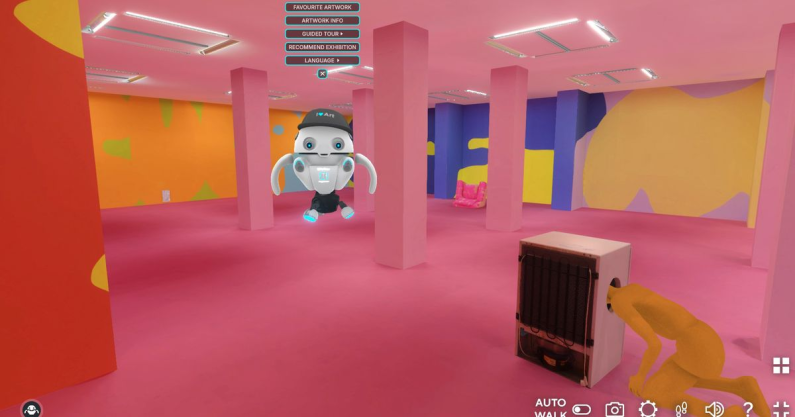
That is what happened with Austrian artist Erwin Wurm’s exhibition Life Beat Soft Melt at the Ludwig Museum in Koblenz, Germany. In the physical museum, the exhibition closed in November 2025. Before it ended, however, the space was transferred into a digital environment: the galleries, the arrangement of the works, and even the visitor’s route through the exhibition were preserved as a virtual twin. Now people can continue walking through the exhibition online even though it no longer physically exists.
This is noticeably different from a typical virtual tour, where the user simply switches between panoramic views or looks at photographs of artworks. Here, it is the spatial experience itself that is preserved: you can move between the works, approach them from different angles, and see the exhibition in roughly the same sequence as a museum visitor would have seen it.
The result is a strange paradox. The exhibition is closed — and at the same time, it continues to exist. You can visit it after it has ended, from anywhere in the world.
Digital twins like these are gradually changing the very idea of what a museum archive can be. And this is no longer limited to art. Digital replicas are also being created for historic buildings, archaeological sites, and other forms of cultural heritage. Sometimes this is a way to provide access to a place that is difficult to visit. Sometimes it is an opportunity to preserve its condition in case it is damaged or destroyed.
But this raises a new question. If a digital place can be preserved, who will preserve the digital places themselves? After all, virtual worlds disappear too.
Final Stop: A Museum of Places That Don’t Exist
An old computer game can face the same problem as a destroyed building. The only difference is that it disappears much more quietly.
A server shuts down, and a virtual city becomes inaccessible. A company stops supporting a platform, and the spaces created by users disappear along with it. Hardware becomes obsolete, and a world that thousands of people once entered can no longer be launched at all.
That is why virtual reality now has its own keepers of history.
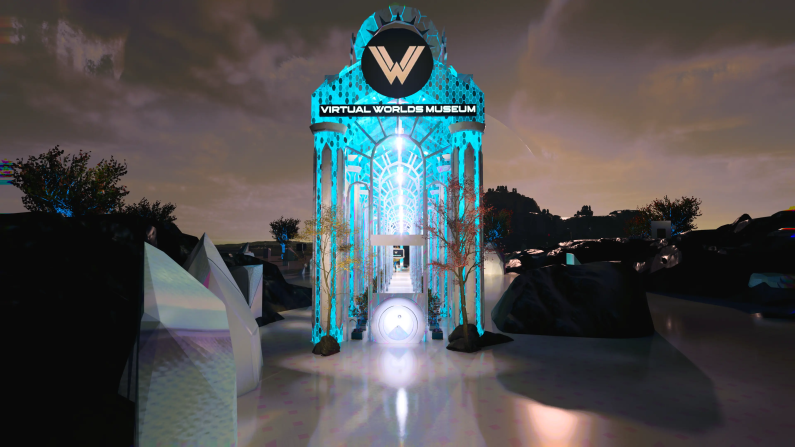
The Virtual Worlds Museum is dedicated to exactly this: collecting information about virtual worlds from different generations and trying to preserve the memory of what they looked like, who created them, and what users did there. Its collection brings together early virtual reality experiments, social VR platforms, and contemporary digital spaces.
In August 2026, the museum launched Teleportal for Meta Quest headsets. The idea is almost perfectly suited to the final stop on our journey: the user enters a virtual space devoted to other virtual spaces. From there, they can explore the history of digital worlds and move on to those that still exist and remain accessible today.
But behind this rather amusing idea lies a serious problem. We know how to preserve paintings for centuries and buildings for millennia, yet a digital world sometimes does not even outlive its own creators. For it to continue existing, it needs servers, software, compatible hardware, and a company or community willing to maintain all of it.
History already has examples of such disappearances. Online worlds have shut down along with their servers, mobile games have become inaccessible after services were discontinued, and user-created spaces have vanished when platforms ceased operating. Unlike an abandoned building, which you can at least theoretically travel to, a deactivated virtual world can disappear completely.
That is why the idea of a museum of virtual spaces no longer sounds quite so strange. If people spent years meeting in a digital city, building things there, organizing events, and making friends, then that city also becomes part of culture — even if it could never be found using geographic coordinates.
Travel Without Geography
The Backrooms, 404_LAND, the digital twin of a museum exhibition, and the Virtual Worlds Museum are all completely different. One place was invented by the internet, another was created by artists, the third once existed physically, and the fourth is trying to preserve the history of all the others.
But together, they reveal an intriguing shift. To perceive a space as a real place, it seems we no longer necessarily need to be able to physically enter it.
We can remember the way through a virtual city, recognize its rooms, return to favorite locations, and feel nostalgic for an online world that shut down several years ago. All that is required is the sense that the space exists and that it is possible to move through it.
And this geography already has its own abandoned buildings, museums, tourist routes, and places that have to be rescued from disappearing.
The only thing you still cannot bring back from the Backrooms is a fridge magnet.
Share this with your friends!

Ethan Oakes



 10
10
Be the first to comment
Please log in to comment