


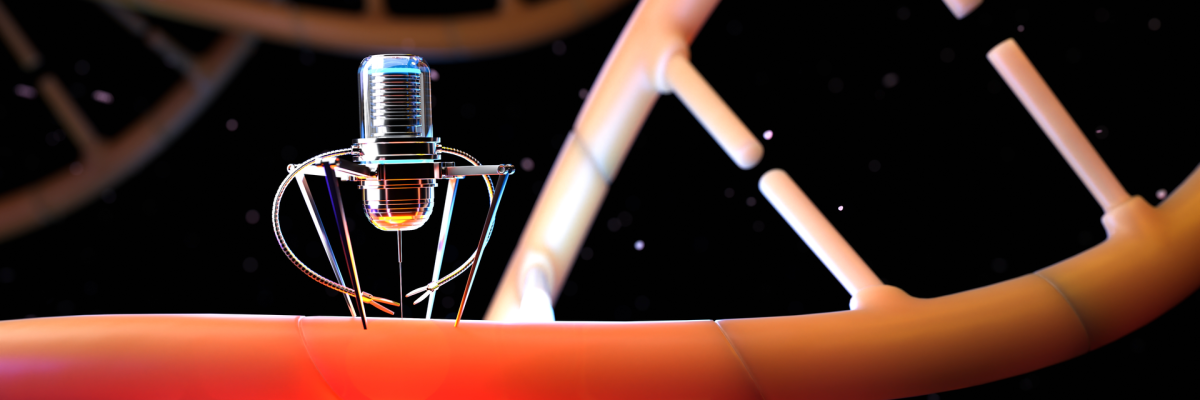
Robots can assemble cars, deliver packages, and even perform surgery. But researchers at the University of Würzburg decided to go in the opposite direction and created a machine so tiny that even a bacterium looks large next to it.
The new robot measures less than one micrometer. That is roughly 50 times smaller than the thickness of a human hair. Yet it can move along a predefined route, turn on command, and, most interestingly, collect and transport bacteria. The device was developed by a team of scientists from the University of Würzburg and the Leibniz Institute of Photonic Technology.
To test how precisely such a tiny machine could be controlled, the researchers gave it an unusual task. The nanorobot had to capture an Escherichia coli bacterium, commonly known as E. coli, and guide it along a path shaped like the number 5. In another experiment, it collected a group of Staphylococcus carnosus bacteria and transported them along a predetermined route. The robot successfully completed both tasks.
At first glance, all of this may seem like an impressive laboratory trick. But controlling objects of this size is actually extremely difficult. Conventional mechanical tools simply do not work at this scale: you cannot take a microscopic pair of tweezers and carefully move an individual bacterium from one place to another. That is why scientists have long been looking for ways to create machines capable of operating directly in the world of cells and microorganisms.
And this raises the main question: how do you make a robot move when it is impossible to install either a motor or a battery inside it?
Light Instead of an Engine
The answer is literally right there in the light. The robot gets its energy from a laser beam.
Its structure contains tiny gold components known as plasmonic antennas. The researchers direct an infrared laser with a wavelength of 980 nanometers at them. The photons transfer momentum to the nanostructure, causing it to move through the liquid.
It may sound unusual, but the principle is fairly simple. Light really can exert pressure on objects. We do not notice this in everyday life because the effect is extremely weak. But when the object itself is measured in fractions of a micrometer, even the momentum carried by photons is enough to set it in motion.
The direction of movement can also be controlled using light. If its polarization is changed — in simple terms, the direction in which the light wave oscillates — the robot turns. With linear polarization, it moves forward, while a short pulse of circularly polarized light allows it to rotate by approximately 90 degrees. This means the researchers do not have to physically move the laser along with the device: they can change its route using the light signal itself.
During the experiments, the nanorobot reached speeds of up to 50 micrometers per second. To us, that is practically imperceptible movement — in one second, it travels a distance roughly equal to the thickness of a human hair. But once you consider the size of the device itself, the figure looks very different: in a single second, the robot can travel a distance many times greater than the length of its own body.
Hunting Bacteria
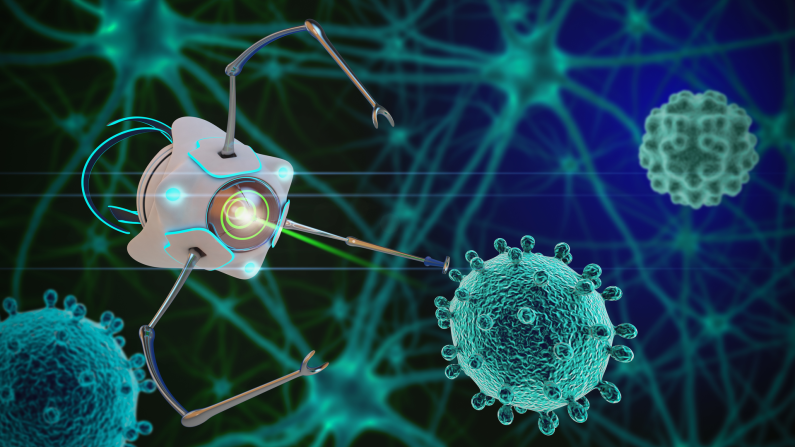
The new robot has no microscopic claws or grippers. To collect bacteria, the scientists once again used light. When the laser hits the robot’s gold components, they heat up slightly. This creates a small temperature difference in the liquid surrounding the device, causing nearby particles to begin moving. This process is known as thermophoresis.
The researchers configured the system so that bacteria gathered around the nanorobot. This created a kind of microscopic “cloud” that the device could carry along with it. When the laser was switched off, the effect disappeared and the bacteria dispersed again.
The robot also proved capable of working with more than a single cell. In the experiments, it collected entire groups of microorganisms and continued moving even when its bacterial cargo was hundreds of times heavier than the robot itself.
That is why the authors describe the device as a nanoscale robotic cleaner. In one experiment, it moved through a selected area of liquid and collected the bacteria present there, literally leaving a cleared zone behind it.
But why create such a tiny “cleaner” in the first place, and where could this technology be useful outside the laboratory? This is where the possibilities become far more interesting than simply cleaning water.
Why Do We Need These “Cleaners” at All?
Of course, no one is planning to use a single tiny robot to remove bacteria from a glass of water. The main value of the development lies elsewhere: scientists now have a tool capable of working with objects roughly its own size — individual bacteria and cells.
Today, optical tweezers, for example, are used for similar tasks. They make it possible to hold and move microscopic objects using a focused laser beam. This technology has been used in biological research for many years, but typically one pair of such “tweezers” works with one object at a time. The Würzburg nanorobot can gather several bacteria around itself at once and transport the entire group to the required location. What is more, in the experiments, this required a laser intensity approximately 100 times lower than that used for conventional optical trapping of bacteria.
This is particularly important when working with living cells. The more powerful the laser, the greater the risk of heating or damaging the object scientists are trying to study. In the new system, the temperature increase remained localized and was less than 10 degrees. The authors of the study note that under these conditions, the impact on biological cells remains minimal.
In the future, devices like these could prove useful in situations where scientists need to do more than simply observe a microscopic object — for example, move individual cells, gather microorganisms in one place, or deliver a substance precisely to a specific location. Among the potential applications, the researchers mention bioengineering, localized sensors, and targeted drug delivery.
The last option sounds particularly promising. In theory, a microscopic device could carry a drug directly to the place where it is needed instead of allowing the medication to spread throughout the entire body. But the current robot is still a very long way from being used in this way.
It Can’t Be Sent Into the Human Body Just Yet
All of the impressive experiments were conducted in a controlled laboratory environment. The researchers placed the robots in an aqueous suspension containing two types of bacteria — Escherichia coli and Staphylococcus carnosus — and observed them through a powerful microscope.
Conditions inside the human body are incomparably more complex. There is blood and other biological fluids, tissues, cells, and numerous obstacles that are absent from a laboratory sample. In addition, the current nanorobot requires an external laser. Infrared light has to reach its gold components and continue controlling its movement, which is considerably more difficult deep inside the body.
There is another limitation as well. At present, the robot mainly moves in two directions within a plane. The authors have already explained how the system could be modified to allow greater freedom of movement, but for now, that remains the next stage of the research.
So it is still too early to imagine an army of such machines traveling through our blood vessels in a couple of years in search of dangerous bacteria.
When Light Becomes a Tool
There is another interesting detail about this development. Scientists usually need light to observe the microscopic world: to illuminate samples, obtain images, and study cells under a microscope. Here, its role has changed. Light simultaneously sets the robot in motion, determines its direction, and helps it collect bacteria.
“This is a striking example of how light can be used not only to observe the microscopic world, but also to actively interact with it,” explains Bert Hecht, a physicist and one of the authors of the study.
And that is precisely why the experiment is more interesting than the amusing nickname “cleaner robot” might suggest. What we have here is not yet a medical nanobot from a science-fiction film, nor is it a ready-to-use device for purifying water. Rather, it is a new way of interacting with a world in which conventional tools become too large.
For now, the robot can perform fairly simple tasks: reach bacteria, collect them, transport them, and release them somewhere else. But until recently, even precisely controlling a machine smaller than one micrometer was a challenging task in its own right.
Now scientists have made such a machine work with living objects that are almost the same size as the robot itself. And if the technology can be developed further, nanorobots may well find applications in places that neither the human hand nor even the finest surgical instrument can reach.
Share this with your friends!

Evan Mcbride




 10
10
Be the first to comment
Please log in to comment