



Imagine one stage of developing a new drug taking place not in a sterile laboratory on Earth, but roughly 250 miles above it.
Samples are launched into orbit, grown for several weeks in microgravity, and then returned to Earth for analysis. At first, the idea sounds impractical: too complicated, too expensive, and too far removed from the realities of the pharmaceutical industry.
And yet pharmaceutical companies and biotech startups are already taking it seriously.
In June 2026, Auxilium Biotechnologies’ AMP-1 orbital bioprinter aboard the International Space Station produced human kidney and liver tissue, cartilage samples, and 28 implants designed to help repair damaged nerves. The materials returned to Earth on June 17 aboard a SpaceX Dragon cargo spacecraft as part of the CRS-34 mission. Researchers must now determine whether the samples retained their intended shape, structure, and biological properties.
But scientists are not interested in producing something in space simply for the novelty of it. The real question is whether microgravity can be used to create tissues, protein crystals, and pharmaceutical materials that are difficult—and in some cases nearly impossible—to produce on Earth.
Why Gravity Gets in the Way
On Earth, gravity is always at work. For the human body, it is simply part of everyday life. But when scientists are growing delicate tissues or protein crystals, gravity can become a serious obstacle.
A bioprinter creates tissue in much the same way a conventional 3D printer produces a plastic object: it deposits material layer by layer according to a digital model.
The difference is that instead of plastic, a bioprinter uses bioink—a mixture of living cells, proteins, and culture medium.
Unlike molten plastic, however, cells do not immediately harden into place after they are printed. They continue to move, interact with one another, and gradually settle under their own weight. While the printer is depositing the upper layers, the lower part of the structure may already be starting to lose its shape.
To prevent this kind of deformation, scientists often use scaffolds—temporary support structures that hold cells in place until the tissue becomes stable enough to support itself.
That solution addresses one problem but can create another. A scaffold takes up space within the tissue and may interfere with the cells’ ability to connect, communicate, and receive oxygen and nutrients.
Microgravity changes the conditions under which tissue forms. When gravity-driven settling and deformation are greatly reduced, delicate biological structures can maintain their three-dimensional shape with less external support. NASA has identified gravity as a major obstacle to bioprinting tissues on Earth, where additional structural and chemical support is often needed to keep cells in place.
That is why researchers are experimenting in orbit with liver, kidney, cartilage, and nerve tissue.
Can an Entire Organ Be Printed in Space?
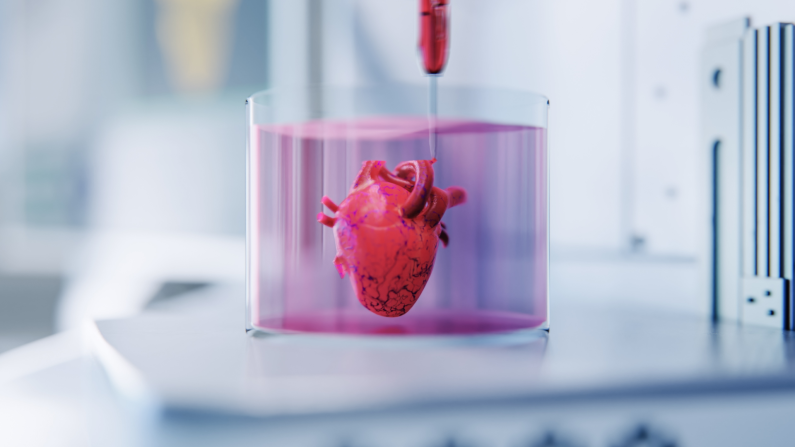
Not yet.
Despite the dramatic headlines, today’s bioprinters cannot produce a fully functioning liver or kidney that is ready to be transplanted into a patient.
An organ is not simply a large collection of cells. It is a complex living system containing blood vessels, nerve endings, connective tissue, and networks of microscopic channels that deliver oxygen and nutrients.
Without that internal infrastructure, a large piece of printed tissue cannot survive. Cells located too far from a source of oxygen and nutrients will quickly begin to die.
For now, scientists are printing small tissue constructs rather than complete organs. These structures are not yet suitable for transplantation, but they may still be extremely valuable to medicine.
Researchers can use them to study how diseases develop, observe how human tissue behaves, and test how cells respond to new drugs. In some cases, a realistic piece of lab-grown human tissue may provide more useful information than a conventional cell culture or an animal model.
The immediate goal, then, is not to print a transplant-ready liver in orbit. It is to create more accurate biological models that can accelerate research on Earth.
Drugs Change in Space, Too
Microgravity affects more than living cells. Researchers also send proteins and active pharmaceutical ingredients into orbit.
To study the three-dimensional structure of a protein in detail, scientists often try to grow it into a crystal. They can then examine the sample using techniques such as X-ray crystallography to determine how the molecule is organized.
As a general rule, the larger and more orderly the crystal, the more precise the information researchers can obtain from it.
Growing high-quality crystals on Earth can be difficult. Gravity causes particles to settle, while temperature differences and fluid motion create convection currents inside the solution. These forces disturb the molecules, causing crystals to grow unevenly or develop structural defects.
In microgravity, sedimentation and gravity-driven convection are greatly reduced. Molecules move more slowly through the solution and can attach to the growing crystal lattice in a more orderly way. Depending on the substance, this can result in larger, more uniform, or higher-quality crystals.
One of the best-known examples involves pembrolizumab, a monoclonal antibody sold by Merck under the brand name Keytruda and used to treat several types of cancer.
Merck conducted a series of pembrolizumab crystallization experiments aboard the International Space Station. The crystalline suspensions produced in microgravity had more uniform particle sizes and distributions, lower viscosity, and greater overall consistency than comparable samples produced on Earth.
The purpose of those experiments was not to manufacture commercial supplies of Keytruda in orbit. Instead, the research helped identify conditions under which more concentrated and uniform drug suspensions could be produced, with the goal of applying those insights to manufacturing processes on Earth.
This approach was explored as one possible path toward a formulation that could be administered by subcutaneous injection rather than through a lengthy intravenous infusion.
In September 2025, the U.S. Food and Drug Administration approved Keytruda Qlex, a subcutaneous formulation combining pembrolizumab with berahyaluronidase alfa-pmph. The space-based research does not mean that the approved drug is manufactured in orbit, but it formed part of a broader scientific effort to find more practical ways to formulate and administer pembrolizumab.
The Keytruda story illustrates what space-based pharmaceutical research may look like in practice.
The finished drug does not necessarily need to be manufactured in orbit. Space can serve as a specialized laboratory: scientists create an unusual sample, bring it back to Earth, study it, and use what they learn to improve manufacturing on the ground.
Why the International Space Station Is Not Enough
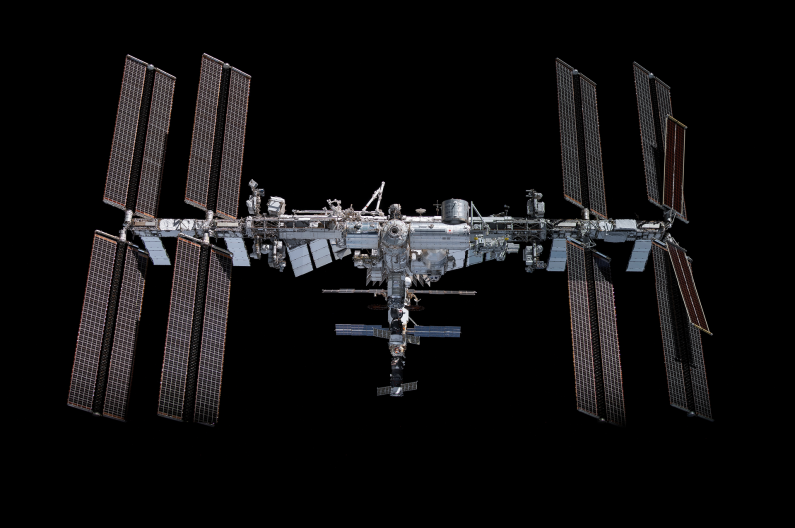
The International Space Station is well suited to early-stage experimental research.
It already has electrical power, scientific equipment, communications with Earth, and a crew capable of installing samples, operating hardware, and adjusting experimental settings.
But the ISS was never designed to function as a pharmaceutical factory.
Every experiment takes up limited space, consumes electricity, and may require valuable astronaut time. Researchers must also work around cargo spacecraft schedules. Samples first have to be delivered to the station and then remain there until transportation back to Earth becomes available.
For fundamental research, a single successful mission can be a major achievement.
The pharmaceutical industry operates differently. A promising result must be reproduced many times. Companies need to demonstrate that a process is reliable, that separate batches are consistent, and that repeating the same experiment under the same conditions produces comparable results.
One spectacular success is not enough. Drug development depends on repeatability, standardization, and predictability.
That is why companies are beginning to develop autonomous orbital laboratories—spacecraft that conduct experiments without astronauts and then return the resulting materials directly to Earth.
A Laboratory That Does Not Need Astronauts
One of the most prominent companies working in this field is California-based Varda Space Industries.
Varda is developing autonomous orbital laboratories that launch aboard conventional rockets, operate in low Earth orbit without a crew, and return experimental materials inside specialized reentry capsules.
Each spacecraft combines an orbital processing module with a heat-shielded return capsule. For several weeks, the onboard equipment can grow crystals, process pharmaceutical compounds, or conduct other experiments in microgravity.
Once the work is complete, the capsule separates from the rest of the spacecraft, reenters the atmosphere at hypersonic speed, deploys a parachute, and lands with the materials produced in orbit.
Varda’s business model is built around turning an orbital experiment into a commercial service.
A pharmaceutical company would not have to design its own spacecraft, secure space aboard the ISS, organize a launch, or arrange for astronauts to operate its equipment. Instead, it could provide the samples and experimental requirements while Varda manages the mission, orbital processing, capsule reentry, recovery, and delivery of the samples for postflight analysis.
During its first mission, W-1, the company grew crystals of Form III of ritonavir, an antiretroviral drug. The capsule returned to Earth on February 21, 2024.
Varda has since increased the pace of its launches and reentries. On May 18, 2026, the company successfully returned its sixth capsule, W-6, which carried technologies designed to advance autonomous navigation and thermal-protection systems.
The company’s next challenge is not simply to prove that an autonomous orbital laboratory can work. It must show that such missions can be flown regularly and produce stable, reproducible results.
That distinction is crucial for the pharmaceutical industry. A single successful sample may be scientifically fascinating, but a manufacturing process becomes commercially useful only when it can deliver the same result again and again.
What Will Actually Be Made in Space?
In the near future, orbit is unlikely to be filled with factories producing packages of pills or thousands of vials.
Instead, space laboratories will be used for specific, high-value stages of research and development where gravity creates a genuine limitation.
The most likely products include protein crystals, new crystalline forms of active pharmaceutical ingredients, specialized biologic formulations, and small samples of human tissue.
These materials do not need to be produced by the ton. For some studies, researchers may need only a few milligrams to examine a substance’s structure and properties in detail.
This is particularly important because the same molecule can sometimes form several different crystal structures, known as polymorphs.
A drug’s crystal form can affect how easily it dissolves, how stable it remains during storage, how practical it is to manufacture, and how quickly it is absorbed by the body.
If scientists can produce a more useful form of a substance in orbit, they can bring it back to Earth and attempt to reproduce it in a conventional laboratory.
In the best-case scenario, space may be needed only once—to reveal a structure or manufacturing process that researchers had been unable to discover under normal gravity.
The method could then be adapted for large-scale production on Earth.
But that will not always be possible. Some materials may prove too difficult to reproduce outside microgravity. In those cases, orbital processing may have to become a permanent part of the manufacturing chain.
That would represent a far more ambitious model—one in which space serves not only as a research laboratory, but as a genuine production environment.
Why Space-Made Drugs Will Be Expensive
The greatest obstacle is cost.
Even a small capsule must be launched into orbit, powered and monitored while it is there, and then returned safely through Earth’s atmosphere. The equipment and samples must survive launch vibrations, temperature changes, radiation exposure, atmospheric reentry, and landing.
For ordinary, inexpensive drugs, the economics simply do not work. The cost of the orbital stage would be far greater than any likely benefit.
The first commercially viable candidates are more likely to be complex, high-value medicines that are already manufactured in relatively small quantities.
These could include antibody-based drugs, treatments for rare diseases, advanced biologics, and certain cancer therapies.
For drugs like these, even a modest improvement may justify the additional expense.
A better crystal form might make it possible to reduce the required dose, extend shelf life, improve stability, simplify transportation, or change the way the drug is administered.
A treatment that currently requires a lengthy intravenous infusion, for example, might eventually be delivered through a quick injection. That could make therapy more convenient for patients, reduce the burden on healthcare facilities, and cut the time and resources required for each procedure.
Even then, companies will have to weigh the potential benefits against the cost and complexity of orbital manufacturing.
Space will make commercial sense only when achieving the same result on Earth is impossible—or when doing so on Earth would be even more difficult and expensive.
Space Will Become One More Laboratory
Most drugs of the future will still be manufactured on Earth.
This is where the pharmaceutical industry’s factories, research centers, supply chains, quality-control systems, and regulatory infrastructure already exist. There is no economic reason to move conventional mass production into orbit.
But selected stages of drug development may increasingly take place in space.
Researchers may use microgravity to grow more uniform protein crystals, create delicate tissue structures, test new manufacturing processes, and discover forms of pharmaceutical compounds that are difficult to produce under normal gravity.
The central challenge over the next several years will be turning these experiments from exceptional missions into routine, predictable operations.
Today, every orbital experiment remains an expensive and technically demanding project. But if autonomous laboratories can begin flying on regular schedules, returning samples quickly, and consistently reproducing results, pharmaceutical companies may eventually treat them as another standard research tool.
A customer standing at a pharmacy counter will probably never know that one stage in the development of a drug took place hundreds of miles above Earth.
The packaging will not say “Made in Space.”
And yet a few weeks in microgravity may one day determine how stable a drug is, how easily it can be administered, and how effectively it works.
Share this with your friends!



 10
10
Be the first to comment
Please log in to comment