


Until recently, the pinnacle of engineering was considered to be a precise 3D model—a digital prototype of anything from a jet engine to a skyscraper. But such a prototype had a fundamental flaw: it was static. As soon as the real object rolled off the assembly line or was constructed, its digital copy became a useless artifact, quickly losing its connection to the original.
Today, we are witnessing a quiet revolution, comparable in scale to the advent of the Internet of Things. It is a transition from digital models to digital twins. This is no longer just a picture, but a living virtual entity powered by data that is born together with the physical object, grows, ages, wears out, and even "falls ill" in sync with it. In other words, a digital twin is a 24/7 live stream of an object's life, where every change in reality is instantly reflected in a virtual mirror.
The Anatomy of a Twin: How Data Breathes Life into a Virtual Copy
A digital twin is a complex, multi-layered ecosystem. Its creation and life can be divided into three key stages:
1. The Physical Object and Its "Nervous System"
Everything begins with equipping the real-world "twin"—a specific physical object—with numerous sensors, its digital nervous system. For an industrial machine, these are vibration, temperature, pressure, and load sensors. For a building, deformation sensors, microclimate sensors, and pedestrian movement sensors. For a person, for example, participating in a medical program, readings from a smart bracelet, MRI data, a genetic profile, and trends in biochemical test results. These sensors constantly capture thousands of parameters describing the object's state in real time.
2. The Virtual Model
A stream of "raw" data flows through secure channels into the digital space—to cloud platforms like NVIDIA Omniverse, Siemens Xcelerator, or Microsoft Azure Digital Twins. Here resides the virtual 3D copy of the object, its skeleton. But to bring this skeleton to life, a set of mathematical and physical models is needed, as well as artificial intelligence algorithms. Here, AI acts as a universal translator and analyst: it learns to understand how changes in some parameters (for instance, an increase in bearing vibration) inevitably lead to changes in others (a rise in temperature and, ultimately, a crack). It uncovers hidden patterns invisible to the human eye.
3. Life in Two Worlds: The Feedback Loop
This is the most critical stage. A two-way connection is established between the physical object and its twin.
-
From Reality to Virtuality: Data from the sensors constantly updates the twin, making it "age" and "wear out" exactly like the original.
-
From Virtuality to Reality: Experiments impossible in reality can be conducted on the simulated twin. What happens if the load is increased by 50%? How will the structure behave during a record-breaking hurricane? What drug dosage will be optimal for this virtual patient? Having received answers in the simulation, the optimal settings or failure predictions are sent back to the real world. This allows us not to react to a failure, but to foresee and prevent it.
Thus, the digital twin becomes a testing ground for managing the future. It blurs the line between design, operation, and maintenance, creating a continuous lifecycle for the object.
Real-World Case Studies
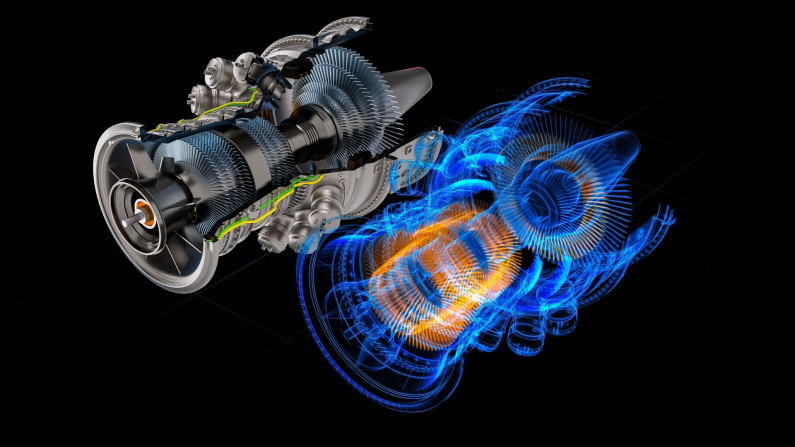
Digital twin technology has moved beyond laboratories and become a working tool in a wide variety of fields.
Aviation: The Twin That Predicts Failure
Leading aircraft engine manufacturers like Rolls-Royce and General Electric have been using digital twins for every engine produced, such as the Trent XWB model, for several years now. In flight, thousands of sensors on the real engine transmit data on temperature, pressure, RPM, and vibrations to its virtual copy on the ground. Algorithms trained on historical failure data analyze the slightest anomalies in real time. They can predict the wear of a specific turbine blade hundreds of hours before a critical condition, allowing technicians to perform precise maintenance just in time, rather than on a rigid schedule or after a failure. This is a revolution in approach: from scheduled maintenance to predictive maintenance, which saves millions and enhances safety.
Medicine: Personalized Therapy
One of the most promising and ethically complex frontiers is the creation of digital twins of humans. Projects in this area are still largely research-oriented, but progress is astounding.
-
The European "Neurotwin" Project: Scientists are creating digital twins of the brains of patients with Alzheimer's disease. A model built on individual MRI and EEG data simulates the spread of pathological proteins. This virtual copy is used to test how different types of electromagnetic stimulation might slow or halt the disease before applying therapy to a real person.
-
Oncology: Companies like Unlearn.AI (USA) create digital twins of patients participating in clinical trials of new drugs. The twin, based on the patient's medical history, genetics, and biomarkers, models the probable course of the disease without the patient taking the actual drug (a so-called "virtual control group"). This allows for cleaner data on the drug's efficacy and may shorten the timelines of costly trials.
Smart Cities: The Metropolis as a Living Organism
Digital twins of cities are perhaps the most complex and comprehensive projects. They integrate data on infrastructure, transport, energy grids, communications, and even people movement.
-
Singapore — Virtual Singapore: This dynamic 3D model of the entire city-state, fed by real-time data, is the gold standard. Officials use it for a multitude of tasks: from planning new districts and analyzing sunlight on building facades to simulating smoke spread during a fire or crowd movement during mass events. Where should a new metro line be built to ease traffic? How to redirect water flows during heavy rain to avoid flooding? The answers are first sought in virtual Singapore.
-
Helsinki (Finland): Here, the city's digital twin is a tool for achieving carbon neutrality. Authorities model how replacing heating systems in a certain district or launching new bus routes will affect overall CO₂ emissions by 2030.
-
Rotterdam (Netherlands): In this city battling the sea, the digital twin helps manage sluices and dams by simulating the consequences of storm surges and making proactive decisions about water discharge.
Industry and Energy: The Failure-Free Plant and Resilient Grid
The examples of Siemens and BMW, described in previous materials about the metaverse, are precisely the story of digital twins. BMW's plant in Regensburg exists in NVIDIA Omniverse as an exact copy, where robot placement can be optimized, new car models can be tested on a virtual assembly line, and employees can be trained without halting production.
In the energy sector, for instance, the Danish operator Energinet (mentioned previously in the context of AI for weather forecasting) uses digital twins of wind farms and power grids. This enables unprecedented precision in load balancing, generation forecasting, and integrating record volumes of unstable "green" energy into the grid.
The New Reality of Classic Professions
The adoption of digital twins doesn't just automate routine—it transforms the very essence of professions, creating a symbiosis between a human and their virtual assistant.
-
The Doctor-Analyst: The future general practitioner or surgeon will rely not only on intuition and experience but also on forecasts from the patient's digital twin. Their role will shift from diagnosing based on symptoms to interpreting simulation data and making decisions based on modeled treatment scenarios. New specializations will emerge at the intersection of medicine and data science—for example, a clinical bioinformatician who "communicates" with patients' digital twins to tailor the model to a specific case.
-
The Predictive Engineer: A specialist maintaining complex equipment (from trains to power plants) will cease to be a "firefighter" putting out emergencies. They will become a proactive lifecycle manager of the equipment. Their working tool is the digital twin's control panel, displaying forecasts of the remaining useful life of each component. Their task is to plan intervention at the perfect moment, maximizing uptime and minimizing cost.
-
The Simulation-Driven Planner: An urban planner or transportation planner will have in their hands not a static master plan, but a living model of the city. Their work transforms into conducting virtual experiments: "launching" a new traffic scheme, "settling" 50,000 new residents in a developing district, and observing how the system will react in 5 years. This changes the decision-making culture from political and intuitive to one based on data and consequence modeling.
-
The Universal Skill: In all these professions, digital literacy combined with critical thinking comes to the fore. The ability to ask the digital twin the right questions ("what if?"), interpret its answers, and make the final, responsible decision remains with the human. The machine provides options; the human makes the choice.
The Reality Architect: A New Profession at the Intersection of Worlds
The profession of a digital twin architect is already gaining momentum. This is not just a programmer or a 3D designer. This is a universal liaison between the physical and the digital, a kind of "engineer-translator."
What falls within their competence?
-
Deep Domain Knowledge. To build a twin of a pacemaker, one needs to understand medicine and biomechanics. For a twin of a power grid—energy. The architect must speak the language of engineers, doctors, and urban planners.
-
Mastery of Data Integration. Their key task is to establish a seamless and meaningful flow of data from thousands of heterogeneous sensors into the virtual model. They decide which data is critical, how to clean it, and how to link a temperature sensor reading to a specific point on the 3D model of a turbine.
-
Virtuoso Platform Proficiency. They work at the intersection of CAD modeling software (e.g., Autodesk), IoT platforms (e.g., PTC ThingWorx), and simulation/AI environments (such as NVIDIA Omniverse or Ansys). Their role is to ensure their seamless integration.
-
Modeling and Simulation Mindset. They know which physical laws and mathematical models will "animate" a static 3D picture. Should a building's twin account for heat transfer, seismic loads, or people movement? The architect makes this decision.
-
Visualization and Data UX. They create not just an accurate, but also a comprehensible interface panel for the end-user (an engineer, a doctor). How to warn of an impending failure? With a red flashing icon or a complex graph? This determines whether the forecast will be noticed in time and correctly interpreted.
Future in Duplicate
Digital twins are not a utopia of the distant future but a pragmatic tool for today, enabling the transformation of uncertainties into manageable risks. They mark a transition from reacting to events to anticipating them, from universal solutions to personal ones, from managing an object to managing its entire lifecycle.
The next logical step is the emergence of twin ecosystems, where a factory's digital twin will exchange data with the twins of its supplied components and the twin of the power grid that feeds it. And a patient's twin, with the twins of the medicines they take. This will pave the way for modeling the most complex systemic interactions, be it a region's economy or an ecosystem.
However, like any powerful technology, digital twins bring challenges. These are questions of data security (especially medical data), prediction ethics (who is at fault if the algorithm errs in a failure forecast?), digital inequality (will small companies or cities be able to afford such technologies?), and, finally, trust in simulation. There will always be a "reality gap"—the moment when a decision made in an ideal virtual world must be implemented in an imperfect, physical one.
But the trend is clear. Soon, every significant object, process, and, possibly, person will have its digital reflection. And our ability to competently build a dialogue with these reflections will determine whether this double reality becomes a source of chaos or a new, unprecedented tool for creation, safety, and well-being. Your digital twin may already be beginning its life online. And its main mission is to make the life of the original long, efficient, and predictably safe.
Share this with your friends!

Ethan Oakes
 10
10
Be the first to comment
Please log in to comment