



Science is far from being just boring formulas; it is also an infinite space for fantasies, which are nonetheless conditioned by various logical conclusions.
Behind concise theories and highfalutin terms often lie concepts worthy of the pen of the best science fiction writers: holographic universes, time travel, and many others. We have gathered some of the most incredible, seemingly absurd, yet quite serious scientific theories that prove reality is far stranger than any fiction.
No. 1. The Hairy Ball Theorem
Imagine you are trying to comb a hedgehog curled up into a ball. If you stroke it in one direction, somewhere there will still be a quill sticking out the other way, or a vortex will form. This impossible situation illustrates the theorem. Its essence lies in the fact that no matter how hard you try to neatly comb a hairy ball — be it a coconut, a fluffy tennis ball, or, indeed, a hedgehog — you will not be able to lay all the hairs (or quills) perfectly flat. At least one will inevitably stick out. This is not an everyday observation but a strict theorem in the field of topology — a branch of mathematics that studies the properties of space that do not change under continuous deformation.
Formally, the theorem, proven by the Dutch mathematician Brouwer back in 1912, states: "There is no continuous tangent vector field on a sphere that does not vanish anywhere." This conclusion is a consequence of a more general topological theorem and states that any continuous vector field on a sphere has at least one zero point. In the language of meteorology, for example, this means that on Earth at any given moment, there is at least one point where the wind is completely absent (or where it is directed strictly vertically). So, if it seems to you that there is a calm outside — perhaps you are simply standing at that very mathematically predetermined point.
No. 2. The Drinker Paradox or the Drinking Principle
This is a logical paradox that sounds like a joke but is considered a quite serious statement in predicate logic. It is formulated as follows: "In any bar, there is a person with a unique property: if he drinks, then every other patron of the bar will also drink."
But the paradoxical nature disappears upon careful analysis. The statement is true in two cases. The first: if everyone in the bar is actually drinking. Then you can choose any person, and the condition "if he drinks, then everyone else drinks too" will be true. The second, trickier case: if there is at least one teetotaler in the bar. Let's choose him. For him, the condition "if he drinks..." is false because he simply doesn't drink. And in classical logic, an implication with a false premise ("he drinks") is considered true regardless of whether the consequence ("everyone drinks") is true. Thus, the statement is always true. It turns out that the paradox lies in the quirky nature of formal logic.
No. 3. Spaghettification
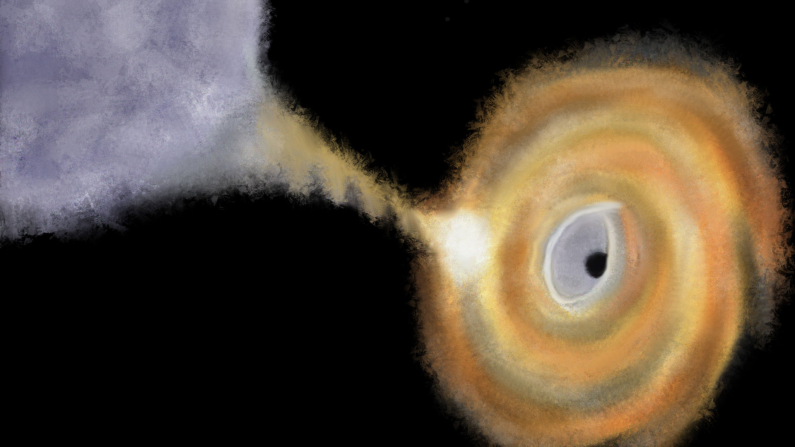
This is not a culinary term, but a eerie prediction of Einstein's general theory of relativity. This is what scientists call the process of vertical stretching and horizontal compression of any object falling into an extremely strong gravitational field, for example, into a black hole. The "noodle effect" — the second name for this phenomenon — is a special astrophysical process as a result of which, due to stretching and compression, objects acquire the form of thin pasta.
Imagine you are falling into a black hole feet first. The forces at your feet, which are closer to the center, will be so much stronger than at your head that you will begin to be incredibly stretched lengthwise while being compressed from the sides. In the end, any object, be it a star, a planet, or a spaceship, will turn into a long, thin stream of elementary particles resembling spaghetti. This process — an inevitable consequence of the curvature of spacetime near a singularity — is so powerful that nothing can withstand it.
No. 4. The Simulation Hypothesis
This philosophical-scientific theory, popularized by Swedish philosopher Nick Bostrom, suggests that our reality is, with high probability, a computer simulation created by a highly developed civilization.
In his article "The Simulation Argument," Bostrom builds his reasoning on three possible future scenarios for civilizations that have reached a "posthuman" level. Either they go extinct before creating simulations; or they lose interest in them; or they create a huge number of simulations of their own history. If the third option turns out to be true, then statistically the number of simulated realities will be orders of magnitude greater than the number of the "base" reality. And therefore, with very high probability, we are living precisely in one such simulation.
Bostrom suggests that if our civilization reaches a "posthuman" stage, it will most likely run many simulations of its ancestors using supercomputers.
Since the number of possible simulations far exceeds the number of "original" realities, if at least one of the first two statements is not true, then the most probable conclusion is that we are simulated beings.
This theory raises questions about the nature of reality, consciousness, and existence, as well as whether we can prove that we are not part of a simulation.
No. 5. Schrödinger's Cat
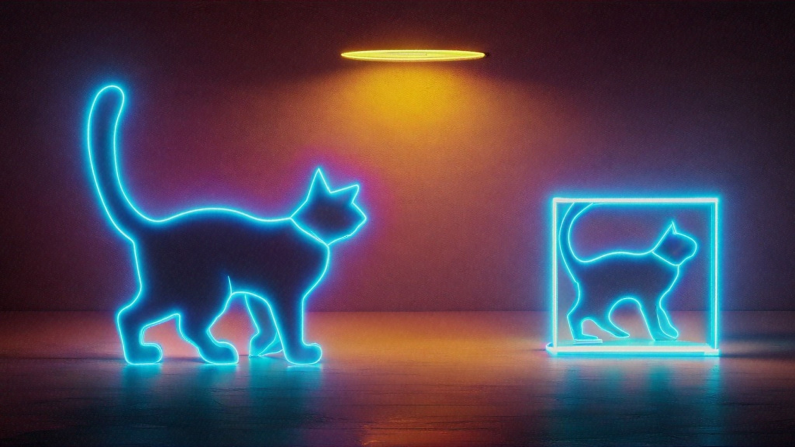
A famous thought experiment proposed by one of the founders of quantum mechanics, Erwin Schrödinger, in 1935 to show the absurdity of the Copenhagen interpretation of quantum physics when applied to the macro world.
Schrödinger's cat is a thought experiment illustrating the principle of quantum superposition, according to which quantum particles can be in several states at once until they are measured. In the experiment, a cat in a closed box is both alive and dead until the box is opened and an observation occurs, which then determines one of the two states.
How the experiment works:
-
A cat, a radioactive substance, a Geiger counter, and a flask of poison are placed in a sealed box.
-
The probability of a radioactive atom decaying within a certain time is 50%.
-
If the atom decays, the counter registers it, activates a mechanism that breaks the flask of poison, and the cat dies.
-
If the atom does not decay, the cat remains alive.
-
According to quantum mechanics, while the box is closed, the system is in a superposition: the atom has both decayed and not decayed.
-
Since the cat's fate is directly linked to the decay of the atom, the cat is also in a superposition: it is both alive and dead.
The goal of the experiment is to show the absurdity of directly applying the principles of quantum mechanics to macroscopic objects like cats. It also raises questions about the boundary between the world of micro-objects and the macro world, as well as the role of the observer in quantum physics.
No. 6. Quantum Suicide Theory
This is a thought experiment illustrating the many-worlds interpretation of quantum mechanics. It suggests that if a person were in a situation where their life depends on a random quantum outcome (for example, a shot from a gun attached to a device measuring a quantum property), then from the point of view of their subjective consciousness, they would always survive.
How it works:
-
Many-Worlds Interpretation: According to this theory, with every quantum measurement, the universe does not choose one outcome but branches into many parallel universes, in each of which one of the possible events is realized.
-
"Quantum Gun": In the thought experiment, this is a device that, with each pull of the trigger, measures the spin of an elementary particle. If the spin is clockwise — the gun fires; if counterclockwise — it clicks.
-
Division of Consciousness: In some universes the person dies, but in others, where the gun clicked, they survive.
-
Subjective Immortality: Since consciousness can only exist in those realities where the person is alive, they will never experience the moment of their death. For them, only that version of reality will ever exist where the experiment ended with a click, not a shot.
The experiment helps to explore the consequences of quantum mechanics, not to prove the reality of parallel worlds. It shows that from the point of view of an observer who continues to exist, they will never die within the framework of such an experiment, provided the many-worlds interpretation is true. It is also closely related to the concept of "quantum immortality," which asserts that self-aware beings are, in a certain sense, immortal.
These several theories and paradoxes are just the tip of the iceberg. They show that science is not a set of dogmas, but a living, constantly changing sphere. The willingness to ask absurd questions, support them with ironclad logic, and not fear surreal answers drives human cognition forward — from understanding the movement of wind on Earth to the mysteries of black holes and the very structure of reality. In the world of science, the craziest idea today may become a fundamental truth tomorrow.
Share this with your friends!

Mizrakhi Katya




 10
10
Be the first to comment
Please log in to comment