


If you believe in life beyond our planet, then one of the most significant discoveries of last year is sure to be right up your alley! Astronomers from the University of Cambridge have found markers of life outside the Solar System — on the exoplanet K2-18b. The planet is located approximately 124 light-years (or about 38 parsecs) from Earth. It lies in the constellation Leo and orbits the red dwarf star K2-18.
The Planet is Showing Signs of Life
During observations, researchers detected large amounts of dimethyl sulfide and dimethyl disulfide. On Earth, molecules of these compounds are produced only by living organisms, such as algae. Astronomer Nikku Madhusudhan, one of the study's authors, stated that humanity has, for the first time, seen potential biosignatures on a habitable-zone planet.
Exoplanet K2-18b was discovered in 2015 using the Kepler space telescope. The planet is also called a "super-Earth" due to its mass — it is roughly 2.6 times larger and 8.6 times more massive than Earth.
In fact, talk of the possible existence of life on the planet began as early as 2019, when another telescope — Hubble — detected water vapor in its atmosphere. Then, in 2023, astronomer Madhusudhan reported the first signs of dimethyl sulfide, which consists of sulfur, carbon, and hydrogen, on K2-18b. Just last year, the scientist and his colleagues conducted a follow-up study of the planet and identified an even stronger marker of this molecule.
But It Proves Nothing
However, the findings of this study have faced criticism from many other astrophysicists. They argue that the results are not so clear-cut. All participants in the discussion, including scientists from NASA and researchers from leading global universities, agreed that additional observations of K2-18b would be beneficial. NASA now states that the elements detected on the exoplanet, hailed as markers of life, could have also formed as a result of ordinary chemical reactions.
Of course, the detection of dimethyl sulfide and dimethyl disulfide will not serve as proof of the existence of aliens, but it could significantly bring us closer to answering the question: Are we alone in the universe?
Where Else Could Life Exist?
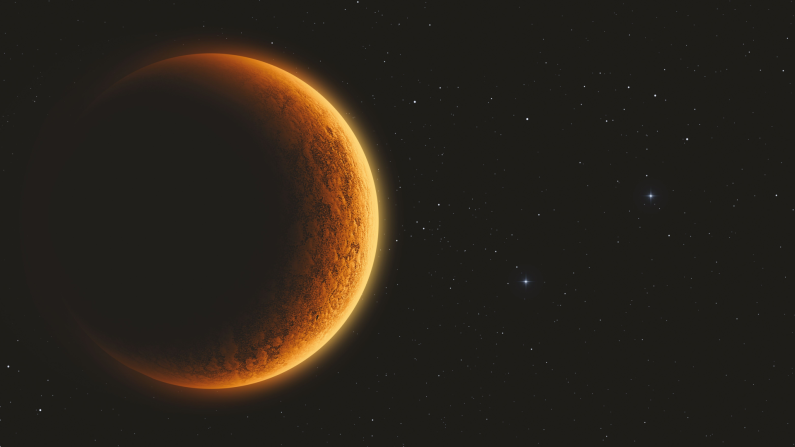
While some scientists debate the nature of the signals from K2-18b, NASA continues its systematic search for worlds similar to our own. In January 2026, an international team of astronomers announced the discovery of exoplanet HD 137010 b, located 146 light-years from Earth. This world is unique because its size is only 6% larger than Earth's, and its year lasts 355 days. It is the first exoplanet with such parameters orbiting a Sun-like star.
The search for extraterrestrial life is not only conducted trillions of kilometers away but also literally "right under our noses" — in the Jupiter system. In February 2026, new data emerged that both brings closer and pushes back the prospect of discovering life on Jupiter's moon — Europa.
On one hand, analysis of data from NASA's Juno spacecraft showed that Europa's icy shell is about 29 kilometers thick, with a vast ocean of liquid water beneath it. Moreover, instruments detected voids and cracks in the ice, indicating geological activity on the moon — a factor favorable for the emergence of life.
However, a parallel study published in January 2026 points to a serious problem: geological activity on Europa's ocean floor may be minimal. Scientists believe there are no active underwater volcanoes or hydrothermal vents there, which on Earth are considered "oases of life." "It seems there simply isn't enough energy to support life, at least not today," stated Paul Byrne from Washington University. The final answer will come from NASA's Europa Clipper and ESA's Juice missions, which are set to begin studying the moon in the coming years.
The Bottom Line
The story of exoplanet K2-18b has become a perfect illustration of how modern science operates at the edge of its capabilities. On one hand, we received a promising and high-profile signal about the possible existence of life beyond the Solar System. The detection of dimethyl sulfide and dimethyl disulfide made the scientific community and the public hold their breath.
However, it was precisely this enthusiasm that provoked an opposing reaction — a wave of healthy scientific skepticism. Critics remind us that K2-18b is most likely a mini-Neptune with a hydrogen atmosphere and extreme temperatures and pressures that rule out the existence of an ocean as we know it. Consequently, the origin of these mysterious molecules may be not biological, but purely chemical.
Nevertheless, the very fact of this discussion is already a huge step forward. The debate has forced scientists to reconsider the very criteria of the search. While some argue about the nature of K2-18b, others, like astrophysicist Amri Wandel from the Hebrew University of Jerusalem, propose expanding the concept of the "habitable zone." It turns out that conditions for life could exist in places we previously never even considered — for example, on planets tidally locked to their star, or in the subsurface oceans of distant moons.
The next few years will be crucial. The James Webb Space Telescope will continue observing K2-18b. New missions to the moons of Jupiter and Saturn will probe our own "backyard" for signs of life. We are entering an era where we will have enough data to either confirm our solitude or finally acknowledge that we are merely a part of a vast, living universe.
Share this with your friends!

Ethan Oakes



 10
10
Be the first to comment
Please log in to comment