



Scientists and futurists are increasingly discussing the approach of a technological singularity—a moment when artificial intelligence surpasses human intelligence and the pace of change becomes so rapid that predicting the future becomes impossible. While some debate the timing of this event, others are already identifying the first harbingers of the coming storm.
We have examined five technological forecasts based on research data, roadmaps from leading laboratories, and calculations from analytical agencies. Even today, these trends are shaping the agendas of corporations like Google, NVIDIA, and SpaceX, and their realization over the next 15-20 years will reshape the economy, medicine, energy, and the very nature of human experience.
AI as Co-Author of Discoveries: The End of the Era of Accidental Breakthroughs
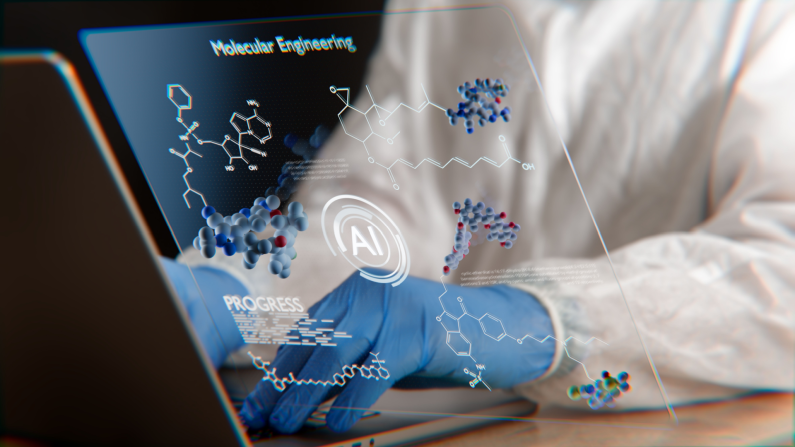
Throughout the history of science, most fundamental discoveries have been the result of a combination of genius, perseverance, and chance: Newton and the apple, Fleming and mold, Einstein and thought experiments. Even today, despite colossal computing power, the process of scientific inquiry remains largely intuitive and slow. Scientists formulate hypotheses, conduct experiments, analyze data—and this takes years.
However, the situation is changing. Already, artificial intelligence systems like AlphaFold from DeepMind are achieving breakthroughs that biologists have struggled with for decades—predicting the three-dimensional structure of proteins with accuracy comparable to experimental methods. Another example is GNoME (Graph Networks for Materials Exploration), also from DeepMind, which, in a few months, discovered over 2.2 million new crystal structures, including hundreds of thousands of potentially stable materials. For comparison: throughout human history, about 200,000 inorganic crystals have been studied.
Analysts from the McKinsey Global Institute predict that by 2040, up to 60% of physical materials could be created or designed using biology and AI. The agency ARK Invest states that AI will accelerate the pace of scientific discovery by 5-10 times over the next decade. Scientists like Demis Hassabis, co-founder of DeepMind, openly state that the goal of their work is to create "AI for science," a universal tool to accelerate all areas of knowledge.
The Quantum Internet: Absolute Security and New Physics in the Cloud
Today's internet is vulnerable. Even the most complex encryption methods (e.g., RSA-2048) could, in principle, be broken by a sufficiently powerful future quantum computer. Paradoxically, another quantum technology could save us from this threat—quantum communication, based on quantum entanglement. Two particles (e.g., photons) can be linked at the quantum level in such a way that a change in the state of one instantly affects the state of the other, even if they are separated by light-years. This is a manifestation of the fundamental non-locality of the quantum world.
Working prototypes already exist. China launched the "Mozi" satellite back in 2016, which established quantum communication between stations over a distance of 1,200 km. In Europe and the USA, ground-based quantum networks spanning hundreds of kilometers have been deployed (e.g., the SECOQC project in Vienna).
The European Union, as part of the "Quantum Flagship" initiative, has allocated €1 billion to create a prototype quantum internet by 2030. China has announced plans to deploy a national quantum network by 2035. Analysts from Boston Consulting Group (BCG) estimate the potential quantum communications market at $5-10 billion by 2030, highlighting the security of critical infrastructure (government agencies, banks, energy grids) as the main driver. Scientists such as Professor Ronald Hanson at Delft University of Technology (Netherlands), whose group first reliably demonstrated entanglement over long distances, believe that creating a global network is a matter of time and engineering.
Scientists suggest the following developments:
-
Absolute Secrecy. Thanks to quantum entanglement (the connection of particles over distance), encryption keys will become impossible to intercept. Any attempt at eavesdropping will be immediately revealed.
-
Networks of Ultra-Precise Sensors. Quantum clocks and sensors connected by such a network will enable earthquake prediction and navigation that are thousands of times more accurate.
-
Cloud Quantum Computing. You will be able to send your quantum task to a remote supercomputer via a special channel and get an accurate result.
The Bionic Body 2.0
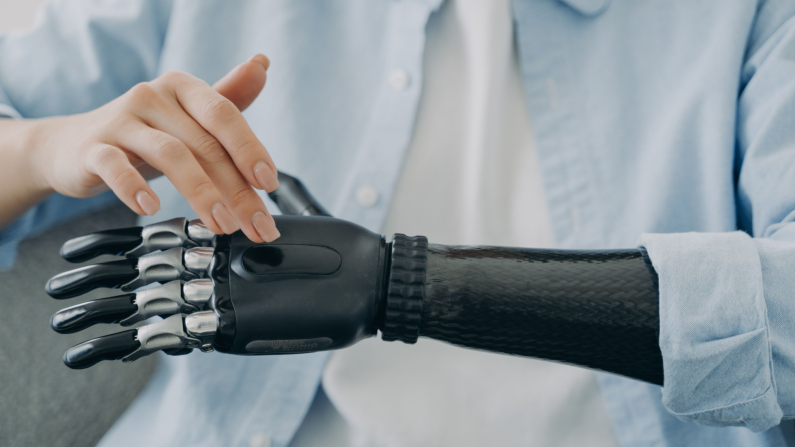
Today, prosthetics and implants are primarily a medical necessity. Bionic prosthetics and neural interfaces (like the chip from Neuralink) help paralyzed people move or communicate. The next step is enhancing the capabilities of a healthy person. Modern bionic hands, such as Bebionic, enable grasping fragile objects; legs enable walking; and cochlear implants enable hearing.
Technologies are already being tested in laboratories that not only restore but also surpass biology. For example, neural interfaces that allow paralyzed people to control an exoskeleton or a computer cursor using their thoughts (the BrainGate project). Retinal implants that give hope to the blind. But the next phase is the voluntary "upgrade" of a healthy body.
The neurotechnology market is growing by 13% per year. DARPA (the Defense Advanced Research Projects Agency of the USA) funds the development of soldier interfaces. Raymond Kurzweil, a renowned futurist and inventor, predicts that by the 2030s, nanobots in our blood will connect our brains to the cloud, giving direct access to all of humanity's knowledge. Although Kurzweil's forecasts are often considered optimistic, the trend is evident. The analytical agency Grand View Research predicts that the global neurotechnology market (including brain-computer interfaces) will reach $24 billion by 2030, with a CAGR (Compound Annual Growth Rate) of about 13%. Scientists such as Professor Miguel Nicolelis, a pioneer in neural interfaces, warn of ethical risks but also confirm the technical feasibility of creating a "brain network."
What awaits us next:
-
New Senses. Implants will allow one to "feel" magnetic fields or see in the infrared spectrum.
-
Chips for Memory and Attention. Hippocampal prostheses will help with Alzheimer's disease and later improve memory in healthy individuals.
-
Round-the-Clock Health Monitoring. Tiny implants will monitor hundreds of blood parameters and warn of diseases years before symptoms appear.
-
Exoskeletons as a "Second Skin." A lightweight suit worn under clothing will enhance muscle strength, aiding in work or in old age.
Climate Management: A Giant "Thermostat" for the Planet
Despite all efforts to reduce emissions, the concentration of CO2 in the atmosphere continues to grow, and global temperatures continue to rise. Scientists' attention is increasingly turning to geoengineering—the deliberate large-scale intervention in Earth's climate system to counteract climate change.
For now, this is a field full of debate and a moratorium on large-scale experiments. But research is underway. The main directions are:
-
Solar Radiation Management (SRM): Spraying aerosols into the stratosphere to reflect part of the sunlight (analogous to the effect of volcanic eruptions).
-
Carbon Dioxide Removal (CDR): Direct capture of CO2 from the air using giant installations (DAC) or enhancement of natural sinks (e.g., the ocean through iron fertilization).
The Intergovernmental Panel on Climate Change (IPCC) has, for the first time, examined geoengineering in detail, recognizing that CDR methods will be necessary to achieve carbon neutrality, while SRM may be considered as a last resort. The Bill and Melinda Gates Foundation funded the Harvard SCoPEx project to study the spraying of calcium carbonate in the stratosphere. Analysts from RAND Corporation and Oxford University publish reports on the geopolitical risks of climate engineering.
What will happen by 2040-2060:
-
Giant "Vacuum Cleaners" for CO2. Industrial installations will appear that will suck carbon dioxide directly from the air and pump it underground.
-
Experiments with a Solar Shield. To quickly lower temperatures, they may start spraying safe aerosols in the stratosphere. This is risky: it could disrupt rainfall patterns in other regions.
-
Climate Geopolitics. The main question will become: who will press the button of the global "thermostat"? This could lead to new conflicts—"climate wars."
Energy Abundance: When Electricity Becomes Almost Free
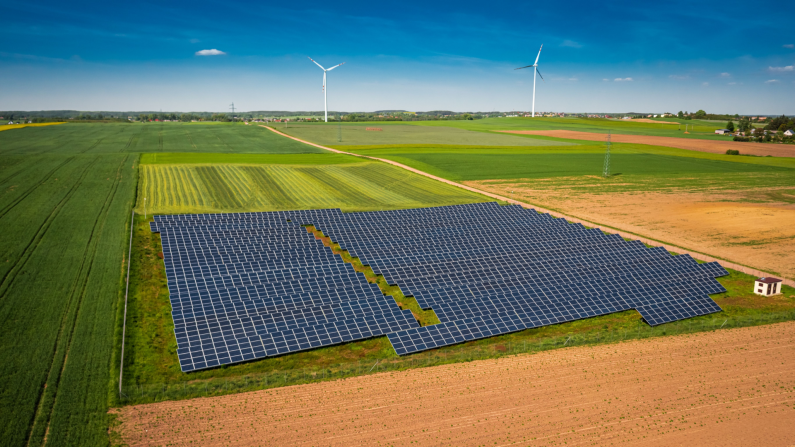
The price of solar panels has fallen by more than 90% over the last 10 years. Already today, in the sunniest regions of the world (Chile, the UAE, some US states), the cost of electricity from new solar and wind power plants is lower than from any new fossil-fuel power plants. Green energy has won the economic competition. But the problem is its intermittency: the sun doesn't shine at night, and the wind dies down. The solution lies in breakthroughs in energy storage.
Promising technologies already exist: lithium-ion batteries that continue to get cheaper, flow batteries for grid storage, gravitational storage (lifting weights), and compressed air. But for a true energy revolution, a technology is needed that radically reduces the cost of long-term (seasonal) energy storage and transportation.
Tony Seba, author of the bestseller "The Dawn of the New Energy Era," and analysts from RethinkX predict that by 2030-2035, the combination of "sun/wind + batteries" will become so cheap that it will completely displace coal, gas, and nuclear energy from the market (except for niche applications) purely for economic reasons. The International Energy Agency (IEA) assigns a key role to solar and wind energy, suggesting that by 2050, they will account for almost 70% of generation.
Scientists such as Professor Donald Sadoway (MIT) are working on ambitious projects, such as liquid metal batteries that can store energy for months. Progress in thermonuclear fusion (projects like ITER, SPARC, and private companies like Helion Energy) also inspires hope, although the timelines here are less defined.
What lies ahead:
-
Desalination of Oceans. With cheap energy, it will be possible to desalinate seawater on any scale, turning deserts into gardens.
-
Fuel "From Air." Water and CO2 from the atmosphere will be used to produce eco-friendly aviation fuel and plastic.
-
Atmospheric Cleanup. Removing excess carbon dioxide from the air will no longer be expensive and will become a common service.
-
Electrification of Everything. Cheap energy will allow for the electrification of all transport, heating, and industry.
The Future Is Being Created Right Now
Each of these trends holds colossal potential for creation, but it also poses serious ethical, social, and existential risks. The future is being created today—by our investments in research, the laws we pass, and the values we follow. The technological singularity is a test of humanity's maturity and responsibility.
Share this with your friends!

Evan Mcbride



 10
10
Be the first to comment
Please log in to comment